
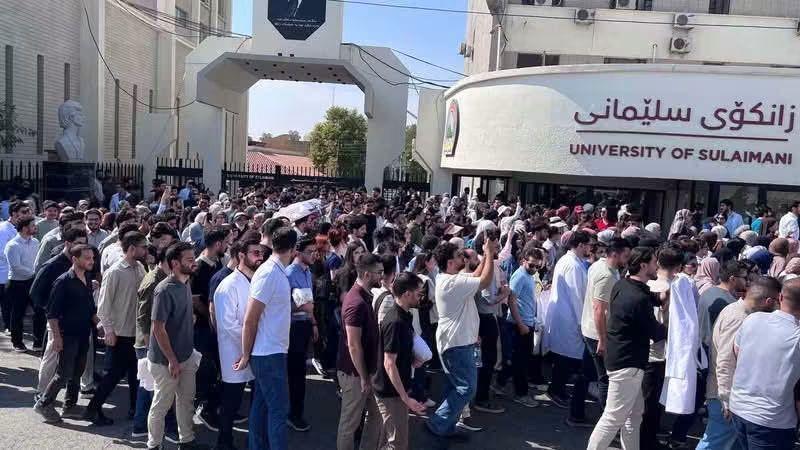

On 27 September 2026, thousands of doctors marched through the streets of Sulaymaniyah in what was arguably the largest healthcare protest witnessed in the Kurdistan Region of Iraq (KRI) in recent years. Beginning at the University of Sulaymaniyah campus and ending at one of the city’s main public hospitals, the march represented a dramatic escalation of a movement that has been building for months.
At the centre of the demonstrations is a simple but deeply consequential demand: employment for approximately 1,400 medical graduates from the 2025 and 2026 cohorts who remain unable to secure positions within the public health system. The march highlights a broader crisis unfolding within Kurdistan’s healthcare system, one that raises fundamental questions about the future of public healthcare, workforce planning, and the right to health.
From guaranteed employment to professional limbo
For decades, the transition from medical school to clinical practice in the Kurdistan Region followed a relatively predictable path: graduates of public medical schools were routinely absorbed into government health facilities. That arrangement ended abruptly in 2025 when the Kurdistan Regional Government (KRG) halted the automatic recruitment of newly graduated doctors.
The consequences were immediate. Rather than merely delaying employment, the decision disrupted the entire medical training pipeline. Existing resident doctors have found themselves unable to leave their current posts to begin specialist training because there are no newly employed graduates available to replace them. The result is a bottleneck affecting multiple generations of doctors simultaneously.
This is not simply a workforce issue. It is rapidly becoming a health system issue. When training pathways are interrupted, specialist shortages become inevitable. The consequences ultimately fall on patients, particularly those who depend on public health services because they cannot afford increasingly expensive private healthcare options.
A crisis amid political paralysis and regional upheaval
Moreover, the doctors’ mobilisation is occurring during one of the most politically uncertain periods in the Kurdistan Region’s recent history.
Two years after parliamentary elections, the region still lacks a functioning parliament and a newly formed government. The two dominant political parties, the Kurdistan Democratic Party (KDP) and the Patriotic Union of Kurdistan (PUK), have thus far failed to agree on a power-sharing arrangement, leaving the region in a prolonged period of political deadlock.
Critical policy decisions affecting thousands of healthcare workers are being made in a context where parliamentary oversight is largely absent and mechanisms for public scrutiny remain weakened.
Relations between Erbil and Baghdad have also remained strained. Disputes concerning revenue sharing, budget transfers, and fiscal authority have contributed to recurring delays in salary payments and uncertainty around public sector financing.
Against this backdrop, health workforce employment has become entangled in a much wider political and fiscal struggle.
The ongoing conflict involving Iran and its associated economic and energy disruptions has also had substantial repercussions for the Kurdistan Region, particularly in provinces bordering Iran. Trade routes have been affected, creating disruptions in supply chains that healthcare facilities increasingly depend upon.
The doctors’ protests are therefore occurring in a health system already under immense strain. Workforce shortages, medicine supply disruptions, political uncertainty, and fiscal challenges are interacting to create a perfect storm for healthcare provision.
While political instability and regional conflict provide important context, they do not fully explain the current situation, however.
Many observers argue that the unemployment crisis among doctors reflects a longer-term policy direction pursued by the KRG since the post-2003 period. At the heart of this approach has been a commitment to reducing public sector employment as a means of controlling expenditure and reshaping the role of the state.
The health sector has been particularly affected.
The process began with restrictions on employment opportunities for dentists, pharmacists, and allied health professionals. It later expanded to affect thousands of nurses. The current dispute can therefore be understood as the latest stage in a broader restructuring process that has now reached newly graduated doctors and resident physicians.
Supporters argue that reducing dependence on public employment is fiscally necessary and may encourage a more efficient healthcare system. Critics, however, view these reforms as part of a gradual shift from a predominantly publicly funded model towards one increasingly driven by private healthcare markets.
Such a transformation carries significant risks. Without robust regulatory institutions, strong accountability mechanisms, and effective social protection systems, market-oriented reforms may deepen inequalities in healthcare access. In a region where many households already struggle with rising out-of-pocket health expenditures, further privatisation could disproportionately affect lower-income and vulnerable populations.
A new generation of medical activism
The current protests have also revealed important changes in the way doctors organise and advocate.
Historically, professional syndicates acted as the primary mechanism through which healthcare workers engaged with government. However, many younger doctors increasingly regard these institutions as ineffective or insufficiently independent. Critics argue that established syndicate structures are dominated by senior physicians whose private-sector positions make them less vulnerable to shrinking public employment opportunities.
As a result, young doctors have increasingly turned towards social media platforms, informal networks, and grassroots organising strategies.
This reflects a broader generational shift seen across many countries, where younger professionals often bypass traditional representative structures in favour of more decentralised forms of mobilisation. The speed with which recent demonstrations have grown suggests that these newer forms of organisation may be capable of mobilising large numbers despite the weakness of formal representative institutions.
The 27 September march represents the largest demonstration of medical discontent seen so far in the Kurdistan Region. Whether it marks a turning point remains uncertain, though.
History offers reasons for caution. Similar employment crises affecting dentists, pharmacists, nurses, and other health professionals ultimately resulted in adaptation rather than policy reversal. Many accepted work in the private sector, sought opportunities abroad, or left healthcare altogether.
Doctors may face a similar trajectory if meaningful policy changes fail to materialise.
A potential short-term solution may emerge from the ongoing debate surrounding Iraq’s 2027 federal budget, particularly if provisions for employing healthcare graduates are extended to doctors in the Kurdistan Region. However, even such a measure would do little to address the underlying structural issues driving the crisis.
The larger question concerns the future direction of healthcare in Iraqi Kurdistan. Is the region witnessing a temporary fiscal adjustment during a period of exceptional instability? Or are these events part of a deliberate and lasting transformation of healthcare provision away from publicly funded services?
The answer will have implications far beyond the employment prospects of recent medical graduates.