
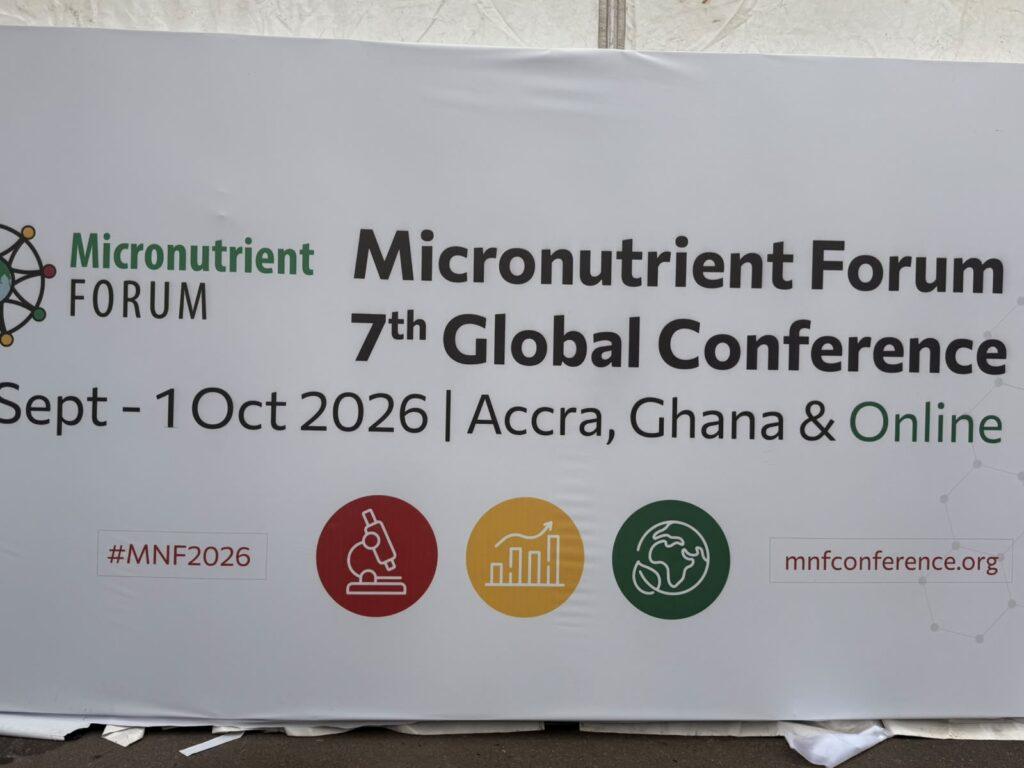

From 28 September to 1 October, I attended the Micronutrient Forum’s 7th Global Conference (#MNF2026) in Accra, Ghana. Under the theme “Nutrition at the Frontiers of a Changing Environment”, the forum brought together the global nutrition community (researchers, programme implementers, policymakers, funders, and experts from different sectors) to discuss how to ensure that no one is left behind in matters of nutrition. The participation of Ghana’s Deputy President, Professor Jane Naana Opoku-Agyemang, underscored the importance of political leadership and commitment to the nutrition agenda.
The Micronutrient Forum is the central platform for evidence and advocacy to improve micronutrient health. Discussions in Accra reflected the changing and increasingly complex nutrition landscape. Key topics included climate change and food insecurity, nutrition in fragile and humanitarian settings, artificial intelligence and nutrition,adoption of the United Nations International Multiple Micronutrient Antenatal Preparation (UNIMMAP) MMS by countries, data quality, research, and product innovation. The forum also emphasized the importance of strengthening scientific quality and evidence availability to support critical nutrition decisions.
Participants highlighted the need for different sectors including health, agriculture, economics, and social sciences to work together and leverage their complementary expertise. Discussions also focused on sustaining important nutrition work despite funding uncertainties and on ensuring that evidence generated through research translates into meaningful action.
Key messages and a call to action
A central message was that nutrition must become everyone’s business. Addressing malnutrition requires strong government leadership, community engagement, cross-sectoral collaboration, quality evidence, innovation, and sustainable financing.
The forum also emphasized that nutrition information systems must be protected and strengthened across the entire data value chain—from prioritization and collection to analysis, communication, and use. Equally important is investment in nutrition research, innovation, and leadership, including developing the next generation of nutrition leaders.
There was a strong call to invest in nutrition now and for the long term. This includes securing predictable, accountable, and coherent financing for nutrition programmes, research, data systems, innovation, and leadership development. Investment must also extend to fragile and humanitarian settings, where nutrition services are particularly vulnerable to disruption.
The call also pleaded for scaling up what works and removing barriers to scale, rather than continuously developing new interventions without addressing the challenges that prevent effective approaches from reaching those who need them.
Way forward
Moving forward, we need to protect nutrition in humanitarian and conflict-affected contexts, promote healthy and sustainable dietary shifts, and strengthen community-based strategies. We must work across sectors to identify and maximize the co-benefits of nutrition integration while strengthening regional, national, and subnational leadership and capacity.
Most importantly, we need to invest in resilience before emergencies occur. Nutrition is not simply a development priority; it is a life-saving intervention. A child may survive malnutrition, but its consequences can extend into adulthood and across generations.
The message from Accra was clear: through collective action, sustained investment, strong evidence, innovation, and political commitment, we can build resilient nutrition systems and ensure that every woman and every child can access the nutrition they need, when they need it.