
In the last three years, women’s health has become more prominent within the global health space with momentum to close the costly $1 trillion gap. This year’s it was one of the World Health Summit’s six themes: Health Equity for Women, Children, and Youth: Ensuring Rights, Inclusion, and Participation. Leaving WHS2026, I can’t help but think that commercializing and commodifying the women’s health agenda while discounting women’s lived experiences as expertise risks reproducing the very inequalities we are working to address.
A million women demand holistic and people-centred systems transformation
Back in 2023, the World Economic Forum (WEF) launched a landmark report exposing the women’s health gap: women will spend more than 25% of their lives in poorer health than men, resulting in over 75 million years of life lost globally, with a potential $1 trillion opportunity to grow the global economy if addressed. Since then, the topic has seized the attention of funders, researchers, pharmaceutical companies, and advocates especially as new findings show that only 6% of private healthcare capital is spent on women, less than 2% on women-specific conditions and 90% of that investment concentrated in women’s cancers, reproductive health and maternal health. The report also found that only 5% of clinical trials report sex-disaggregated data resulting in delayed diagnoses for women across 700 diseases.
That same year, I attended my first World Health Summit – and while it was a jarring reality check to be in Berlin for one of the sector’s highest-level dialogues on health diplomacy just one week after the October 7 attacks, with the genocidal response already in full swing in Gaza – it was an honor to carry the voices of 1.2 million women and girls to this convening. My team at White Ribbon Alliance and I launched Beyond the Sum of our (Body) Parts: A Call to Action from Women and Girls — the findings of this “What Women Want campaign” which asked over a million women and girls (aged 6-103) from every region their top demand to improve their health and wellbeing. As scholars and funders were building the women’s health agenda from WEF to WHS, this mass-mobilization participatory priority setting research repositioned women as the experts on their bodies, needs, communities, and solutions. Unsurprisingly, women demanded basic human rights: Person-centred holistic care that respects bodily autonomy. Food security. Financial freedom. Safety from gender-based violence… Across 8 themes, women were demanding systems change that treats them as a whole person.
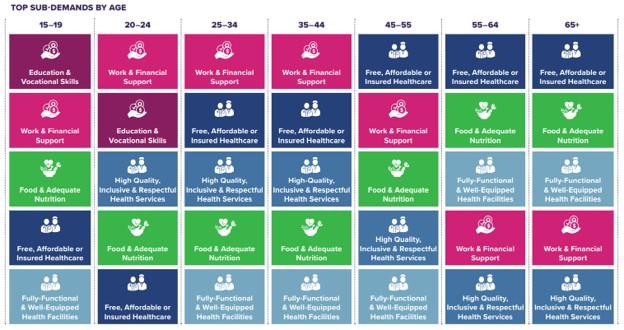
Copyright: White Ribbon Alliance. Beyond the Sum of our (Body) Parts: A Call to Action For Women and Girls. 2023.
Women’s health at WHS2026
Despite millions of women demanding to stop fragmenting women’s health to “the bikini areas” and consider it holistically, the women’s health theme at WHS2026 heavily focused on reproductive and maternal health. I was encouraged by the €250 million investment in Bangladesh’s women’s health, the $100 million to address the current trend of stillbirth every 17 seconds, pharma acknowledging their gender-blindness of the “male body as the standard” in cancer research, and the closing keynote focusing on ending maternal and child deaths. Nonetheless, across both this year’s Women’s Health sessions, funders, pharma companies, UN, and doctors, dominated the stage, without representation from civil society, women’s advocacy organizations, or even women patient groups as their powerful ideas were relegated to the side sessions which have become exorbitantly expensive for grassroots and non-profit advocates.
Health systems of the future will be feminist
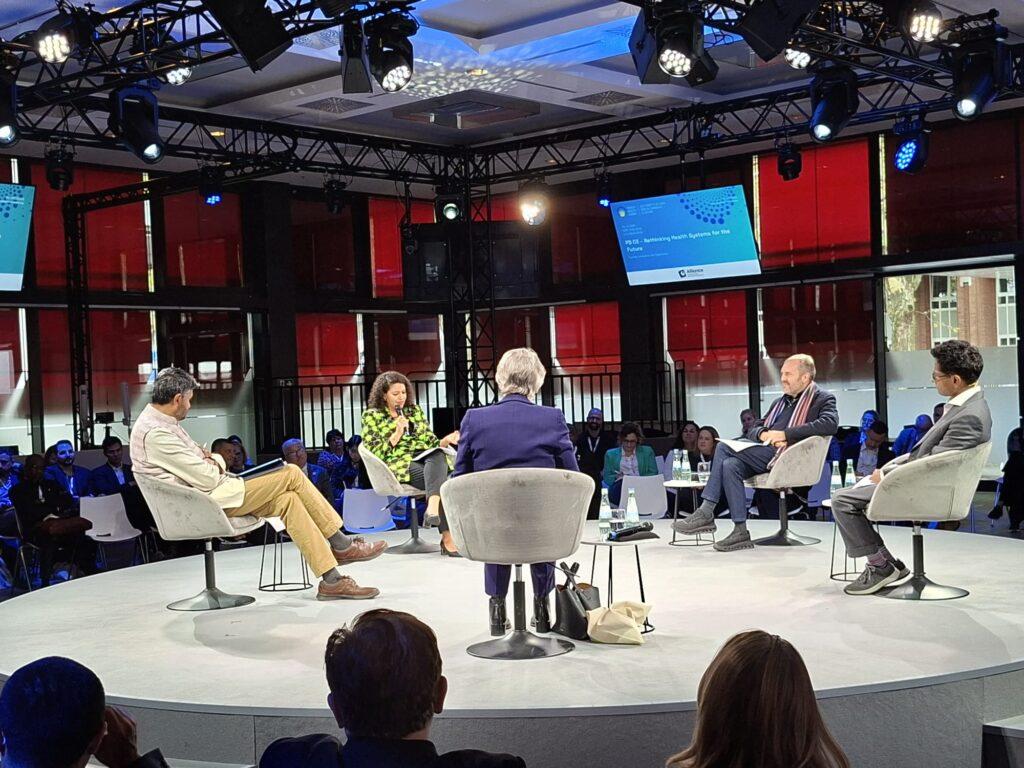
As I joined WHS2026’s opening session on Rethinking Health Systems for the Future, this was my main message: “As we reform the global health architecture, we cannot ignore 50% of the population whether women or youth, in all their diversity, we must meaningfully engage the communities most significantly affected by these new policies, before decisions are made, not after plans are finalized. Health systems of the future will be feminist. What we cannot sacrifice is every person’s RIGHT to HEALTH and holding government accountable to deliver it.”
As we leave WHS26, let’s PUSH to transform women’s health and put women at the center of health systems. Join us as we build the global movement for woman-centred care!