

Primary school teacher Geraldine Achiah had been married for barely two months. In September, she died in Yaoundé, Cameroon. Her relatives allege that she had been beaten to death by her husband after a marital dispute. He denies it and is currently in jail awaiting a murder trial. Achiah is one of nearly 70 women killed in Cameroon in 2026 for reasons connected to their gender, according to the Ministry of Women’s Empowerment and the Family. And those are only the cases that were recorded.
Femicide, the intentional killing of women and girls with a gender-related motivation, is the most extreme form of gender-based violence. Yet under Cameroonian law, it is not recognised as a separate crime from murder; therefore, no police or court register counts it.
“Take accountability too”
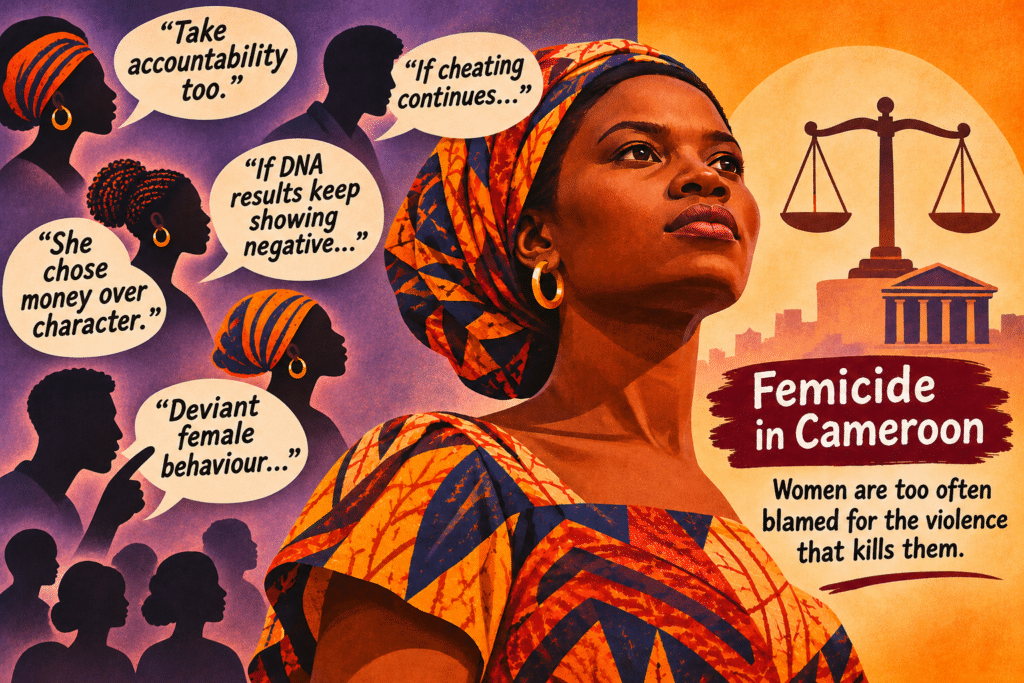
As the hashtag #NoToFemicide spread online after Achiah’s tragic case, a Cameroonian influencer offered her followers a different message, however. It was widely reshared on Facebook by popular bloggers. In the video, she began by saying, “DEAR WOMEN, TAKE ACCOUNTABILITY TOO”. Femicides, she wrote, “will continue if cheating continues”, “if DNA results keep showing negative”, “if women keep choosing money over character”. She closed with what a man “derives his ego from”: his woman, his money, his manhood. “If you are wise, you don’t joke with the above.” She was not alone. In September, a columnist on the news site Camer.be argued that ending femicide requires “re-educating” women. He said he didn’t want to justify murder but nonetheless blamed “deviant female behaviour” that turns men into cash machines, and he dismissed “slogans imported from the West”.
Taken together, these voices turn a killing into a consequence. The man who kills is reacting; the woman who died provoked him. Infidelity, money, disrespect or a paternity dispute is no defence to murder in any courtroom, yet each of these ‘reasons’ is offered as an explanation. Moreover, the influencers’ line about women “staying in abusive relationships” gets the danger backwards. UN Women’s analysis of intimate partner femicide in Kenya found that attempts to leave act as acute triggers for lethal violence.
Excuses, not reasons
These voices echo a long-standing culture of ownership. In many homes, a husband’s infidelity is tolerated as something men do, while a wife’s is treated as provocation. If betrayal explained killing, partners of both sexes would die in similar numbers; instead, women represent 82% of people killed by intimate partners worldwide. The psychiatrist Laure Justine Menguene traces this to a patriarchal society and a violent upbringing in which men “grow up with the idea that they are superior to women.” Viviane Tathi Yende of Stop Féminicides 237, a Cameroonian organisation that tracks femicide cases, cites alcohol and drug abuse, economic stress, the clash between traditional and modern ways of life and, above all, impunity. “There is … a taboo around prosecuting the perpetrators of violence; time and time again, the preference is for an out-of-court settlement”. None of these causes relates to something the woman did. And so while the excuses blame the victim; the evidence points to the men who kill and the system that lets them go unpunished.
The script repeats itself across the continent. In Kenya, women murdered in Nairobi short-stay rentals in 2024 were blamed online for chasing money or clout. In South Africa, a police minister said Karabo Mokoena’s 2017 murder should “serve as an example to all our girls”. At home, women often repeat it too. In her doctoral thesis on women in Bamenda Cameroon, Emmanuella Bih followed women’s Facebook groups for years and found victims blamed in the comments even after they had been killed. The phrase she heard most was “na woman di kee another woman”, which loosely translates to “ it is a woman who kills her fellow woman”. Each excuse makes the next killing easier to explain away. It decides whether neighbours step in, whether police act, and whether a woman believes anyone will help her.
A public health crisis hiding in plain sight
The increase in femicide rate is an indication of a deeper public health crisis. About 32% of women in sub-Saharan Africa have experienced intimate partner violence in their lifetime. Africa also has the world’s highest rate of partner and family femicide. In Cameroon, nearly 4 in 10 women who have had a partner report violence. Yet according to a 2024 PLOS Global Public Health study, the women reaching hospital care after violence tend to be the more educated and better off, indicating that those most at risk stay out of sight until it is too late.
Cameroon promised to halve violence against women by 2026 but so far hasn’t come anywhere close. A femicide bill is on its way but law alone will not undo patriarchal thinking. That requires, among others:
Last but not least, the conversation must change too. Accountability should belong to the men who kill and to the institutions that fail to stop them. No list of a woman’s “faults” ends with her death being deserved.