




Between 2024 and 2025, Developmental Assistance for Health (DAH) declined by 21%, driven largely by a 67% reduction in US financing. Yet, the more uncomfortable question is not why aid is declining, but whether the prevailing model was ever designed to make itself unnecessary. Perhaps then, the greater indictment is not the current retrenchment itself but the collective failure to prepare for it.
The implications of this reduction are particularly acute for Low- and Middle-Income Countries (LMICs), many of which remain heavily reliant on DAH to fund essential health care services. Their predicament continues to dominate much of the global health discourse, even if they are hardly “breaking news.” After all, WHO Director-General Tedros Adhanom Ghebreyesus himself recently acknowledged that the fragilities exposed by today’s funding crisis have been recognised since the 1980s.
Much attention has focused on recent political decisions, particularly recent reductions in longstanding DAH commitments by the US and other major donors. Attributing the crisis solely to contemporary politics risks obscuring deeper structural dynamics, however. If global health financing has always been shaped by strategic interests (of states, philanthropies, …) then the current retrenchment may reflect longstanding tensions rather than an isolated political shift. This is not a defence of any particular administration; rather, it invites a more honest reckoning with the interests the architecture has historically served.
As the discourse shifts from critique (“what has the US done?) to prescription (“countries must prioritise domestic resources“), another question emerges: how can countries build fiscal sovereignty without recreating new forms of dependency?
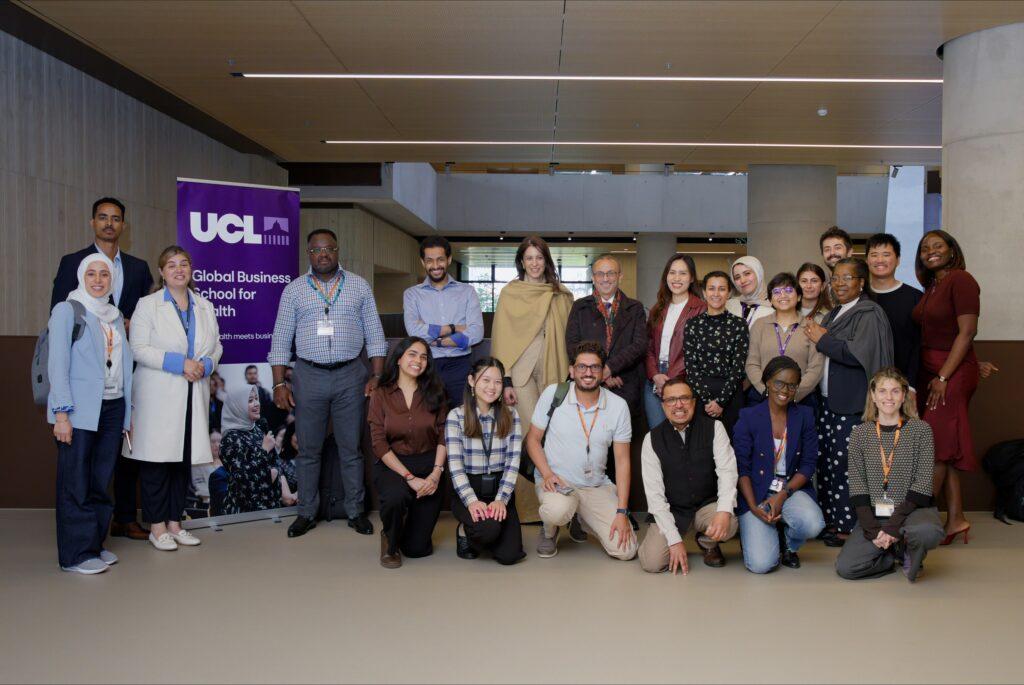
Against this backdrop, the sixth Transforming Health Systems (THS) dialogue convened researchers, practitioners and health systems leaders at UCL Global Business School for Health in London on 8 June 2026 to explore the theme: “Power, Politics and Fiscal Sovereignty: What is the Way Forward for LMIC Health Systems?”
Domestic Resource Mobilisation (DRM) has rapidly become the dominant recommendation for countries facing declining aid. The logic is compelling: no country can sustainably finance its health system through external assistance alone, and strengthening domestic financing remains fundamental to achieving Universal Health Coverage (UHC). However, the dialogue cautioned against treating DRM as an end in itself.
Mounting debt-servicing costs constrain the ability of countries to invest in health; many spend more on debt interest payments than on education and health combined. Several African countries collectively lose more to illicit financial flows and corporate tax exemptions than they gain in aid. These constraints are not incidental, but are the terrain on which DRM must occur. Confronting them carries political costs that few actors are willing to bear, even as all agree the issue must be addressed. This is not an argument against fiscal ownership, but a call to interrogate the instruments that are being promoted.
Private actors are not new to this story although philanthropy and commercial private investment occupy very different positions within the financing landscape. Private investment can bring capital, innovation and capacity, but it also introduces risks around profit incentives, equitable access and accountability. These trade-offs become particularly consequential where regulatory institutions are weak. Therefore, whilst the exploration of private financing is necessary, mistaking a financing gap for a governance gap risks repeating the errors of the donor-recipient era.
Rudolf Virchow’s assertion that “medicine is a social science and politics nothing but medicine on a grand scale” has never felt more relevant. From the very creation of welfare states (see the classical Bismarck and Beveridge models), health systems have always been shaped by political interests as much as by population needs. They were/are designed not only to improve health but also to consolidate power, build economies, and secure political legitimacy.
Financing reforms do not alter this dynamic but simply shift its expression – whether through DAH, vertical funding, results-based financing, or now DRM, each instrument creates new constituencies of power. Multilateral organisations, development finance institutions, foreign governments, and philanthropic foundations have all, at different moments, become influential actors, sometimes drawing decision-making authority away from the communities whose health is at stake.
The question of who drives reform is therefore never merely technical. As panellists emphasised, the interests of those shaping the next generation of financing arrangements will determine whose priorities are reflected. Unless this is named explicitly, new instruments risk reproducing familiar asymmetries under different labels.
The 6th THS foregrounded several key questions for the future of health financing. As the previous era of global health financing draws to a close, the temptation will be to measure success by how efficiently countries replace declining aid. This may be an incomplete metric as the issue is not simply whether countries can mobilise new resources. It is whether emerging financing arrangements will strengthen political ownership, institutional capability, and accountability—or replicate existing imbalances.
Structural conditions also remain challenging: debt is rising, fiscal space is shrinking, and while new opportunities such as private capital and innovative financing instruments are emerging, the central question remains the same: who sits at the centre of these reforms? Governments are being asked to make decisions that will shape whether ordinary people, navigating underfunded, overstretched health systems, are protected or left behind.
The relationship between health and politics is deeply entrenched, and change will inevitably face resistance from those who benefit from the current landscape. So therefore, as a new global health era emerges, will fiscal sovereignty remain an aspiration in scholarship, or finally materialise in practice, enabling LMICs to advance UHC on their own terms?