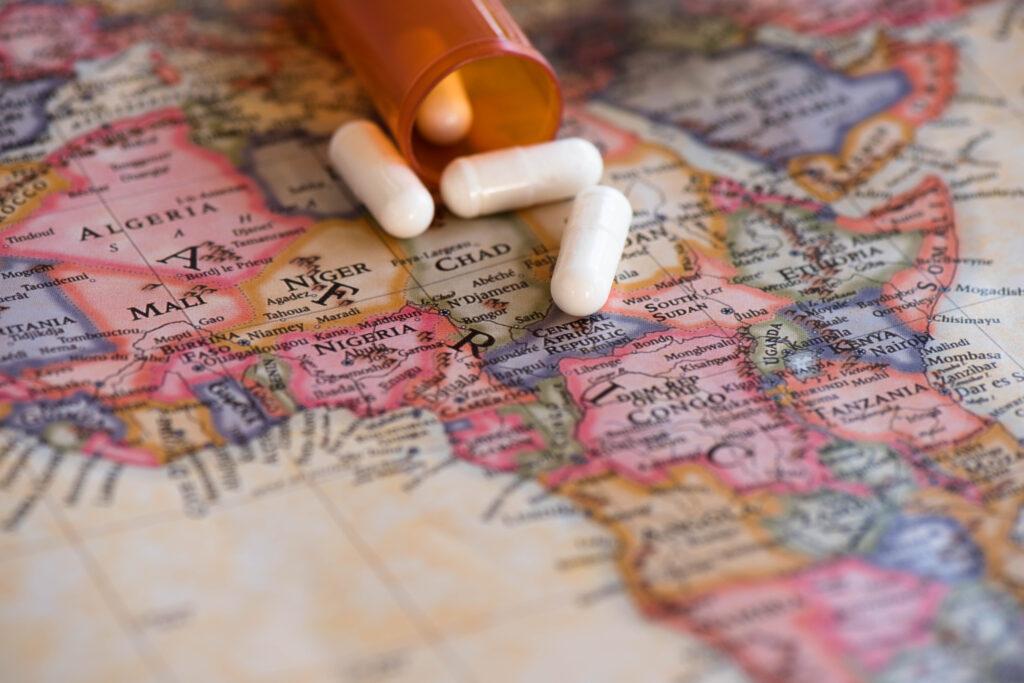

Much of the world is focused on fentanyl. But across Africa, a different opioid catastrophe has been quietly building for years, and it is getting worse.
In the markets of Kumasi, Ghana, a motorbike taxi driver starts his shift before dawn. Before his first passenger, he swallows a handful of small white pills bought the night before from a roadside vendor; no doctor, no prescription, less than the cost of a soft drink. They keep him alert; they dull the ache in his back. They make him feel, as drivers in Ghana have described it, as if he rides like a jaguar. His case is not unusual. Across Nigeria, Egypt, Niger, Togo, Cameroon and beyond, millions of people reach for tramadol every day, not because they want to get ‘high’, but because they cannot afford not to.
A drug born of necessity, weaponised by poverty
Tramadol is an opioid analgesic, used to treat moderate to severe pain. Although it is not included in the WHO model list of essential medicines, it sits on the national essential medicines list of at least fifteen African countries. Morphine, the reference opioid for severe pain, is subject to strict international control, and remains largely inaccessible across sub-Saharan Africa, while tramadol, weaker and less tightly regulated, has emerged as the default. It is therefore often the only analgesic a cancer or sickle cell patient can access in many African settings. That is the tragedy at the centre of this story. The same pill, giving a terminally ill patient in a rural clinic something to hold onto, is also being mixed with alcohol and energy drinks and consumed at two to five times the recommended dose by mostly teenagers, truck drivers, and informal labourers across several African countries.
This is not a story of moral weakness. Long before anyone swallows the first pill, there is already pain; the pain of working a body to exhaustion for wages that cannot cover rent, of untreated illness in health systems never built for ordinary people. The pill does not create that pain. It just becomes the cheapest way to manage it.
The numbers also tell the story bluntly. Among homeless young people in Niger, over 77% were non-medical tramadol users. Among construction workers in Egypt, 92%. Among motorcycle taxi drivers in Nigeria, 76%. Walk into a psychiatric hospital in Cairo, and nearly half the patients will have been taking it without a prescription. In Cameroon, farmers have reportedly given it to cattle to plough fields for longer. The consequences are severe and well-documented: seizures, psychiatric breakdown, mood disorders, anxiety, psychosis and heart damage.
An evolving threat
None of this is accidental. For years, the tramadol flooding African streets was manufactured in India by unlicensed factories producing export-only batches at doses far beyond anything a doctor would prescribe. Seizures across West Africa rose from 17 tonnes in 2014 to 170 tonnes in 2017. India tightened controls in 2018. The traffickers simply switched products. Between 2023 and 2025, over 320 million tablets of tapentadol—an opioid two to three times more potent than tramadol and largely unapproved across West Africa – were shipped from India to the region, with more than half exceeding dosage limits permitted even in India. The Lancet has flagged these new combinations as a key factor escalating the regional opioid emergency. The pipeline has not been shut down; it has been upgraded.
The security dimensions are equally alarming. In 2017, Cameroon customs seized 600,000 tramadol tablets intended for Boko Haram suicide bombers. The United Nations Office on Drugs and Crime (UNODC) has linked tramadol trafficking to the destabilisation of the Sahel. Robberies, rapes, and violent assaults across Gabon, Ghana, and Nigeria have been directly attributed to misuse. At this scale, the crisis extends far beyond public health.
Beyond the Pill: What a Real Response Requires
The problem is clear, but the response has yet to match its complexity.
Tramadol misuse cannot be reduced to control alone. It moves through gaps in enforcement, across borders and into informal markets where regulations exist but are weakly applied. But cracking down alone will not solve it. These same gaps reflect deeper failures: limited access to pain care, fragile health systems, and lives shaped by economic hardship. Stronger regulation is necessary; pharmacies cannot continue to dispense without consequence, but it is not sufficient. Poorly implemented controls may deepen the very problem they seek to address, as they risk restricting access to essential medicines for those who need them most.
What is required is balance: policies simultaneously addressing both the supply and the conditions that drive demand, including economic hardship and exhausting labour conditions. Without this balance, the same gaps will persist.
The motorbike driver in Kumasi is not the problem. He is the outcome. Until systems work for him, he will keep reaching for the pills. And who, honestly, could blame him?
*The author acknowledges María Belén Tarrafeta Sayas for her feedback and expertise during the development of this article.
Such an excellent piece by Dr. Relindis Tapang. Honestly, there is probably no better perspective on this than that of a health economist because the article really shows how this crisis is tied not only to drugs themselves, but to poverty, labor conditions, healthcare access, and everyday survival.
I liked that it did not approach the issue in a simplistic way or treat people using tramadol as just “drug users.” In many places across Africa and the Middle East, people are already living with exhaustion, chronic stress, physical pain, difficult working conditions, and healthcare systems that often do not work for ordinary people.
That line about the motorbike driver really stayed with me because it reflects something we often ignore in these conversations, the truth is that people are not trying to escape reality but are trying to keep going through it.
The author also does an outstanding job showing the tension between controlling misuse and making sure people still have access to pain relief and healthcare. A lot of discussions miss that balance.
Very thoughtful and very well written!