

As development assistance for health declines, many low- and middle-income countries (LMICs) are rethinking how to finance health systems that are equitable, resilient, and increasingly self-reliant. The shift from aid dependence towards fiscal sovereignty is not merely financial; it reflects a deeper transformation in governance, accountability, and ownership within global health. At the same time, constrained domestic fiscal space, increasing geopolitical conflicts, and wider political economy pressures are forcing tougher questions about how health systems can be financed more sustainably and governed more sovereignly. Yet too much of the current debate on health financing remains technocratic, focusing on instruments, models, and efficiency gains without sufficiently grappling with the political realities that shape reform. What is needed now is a more grounded understanding of how countries navigate trade-offs, build coalitions, and make difficult choices under conditions of fiscal constraint.
Countries are expected to do more with less: sustain essential services as aid declines, protect equity under fiscal constraint, and pursue reform in politically contested systems where existing financing arrangements are already fragmented and fragile. In many settings, this means confronting difficult dilemmas: whether to preserve donor-supported programmes or redirect scarce resources towards broader system priorities; how to expand pooled or domestic financing without worsening exclusion; and how to pursue reforms that may be fiscally rational but politically costly. Part of what is not working is that health financing transitions are still too often treated as a question of replacing external funds with domestic resources, rather than confronting the political and institutional conditions that shape whether such a shift is possible. In many countries, donor-supported programmes have operated through fragmented arrangements, while domestic financing systems remain too weak, unequal, or politically constrained to absorb those functions fairly. The challenge, therefore, is not only how to mobilise more money, but how to govern it, reallocate it, and build the legitimacy needed to sustain reform. These are not simply technical questions; they are questions of politics, prioritisation, and power.
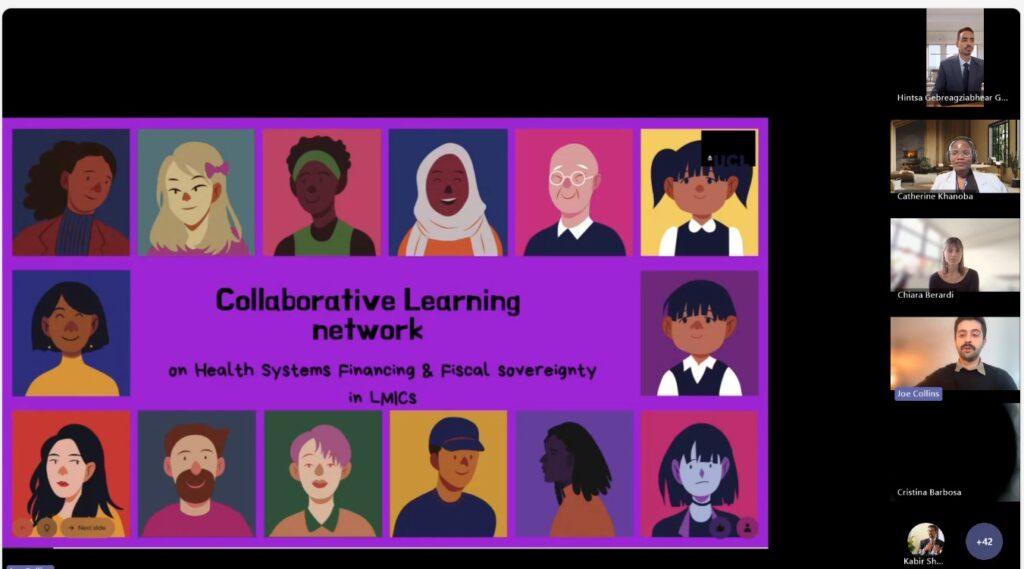
It was in this context that, in February 2026, we launched the Collaborative Learning Network on Health Financing and Fiscal Sovereignty in LMICs (CLN), hosted by the Centre for Global Health Systems and Policy at UCL Global Business School for Health. The CLN is intended as a peer-led, practice-oriented space for early- and mid-career researchers, practitioners, and policymakers to learn from one another’s experience, reflect on difficult reform questions, and build more grounded conversations on financing transitions and fiscal sovereignty. Its purpose is to create a space where reform experiences, political realities, and practical dilemmas can be discussed more openly across countries, disciplines, and roles.
At a time when financing decisions are becoming more contested and resource constraints are deepening, we believe there is immense value in creating spaces where experiences can be shared, ideas can be tested collectively, and new collaborations are forged. What is needed now is not simply more technical guidance, but more honest learning: sustained dialogue that connects evidence to politics, learning to practice, and country experience to broader debates on reform. Technical frameworks alone will not resolve dilemmas that are fundamentally political and institutional. What is at stake is not only financial sustainability, but whether the move away from aid leads to stronger public stewardship or simply deeper fragmentation and inequity. The launch of the CLN is only a first step, but it reflects a wider conviction that navigating health financing transitions and strengthening fiscal sovereignty in LMICs will require more politically grounded, context-sensitive, and collaborative ways of thinking and acting.
The Network welcomes new members on a rolling basis. Applications are accepted throughout the year, with screening conducted every six months, and interested applicants can apply via the application form.