
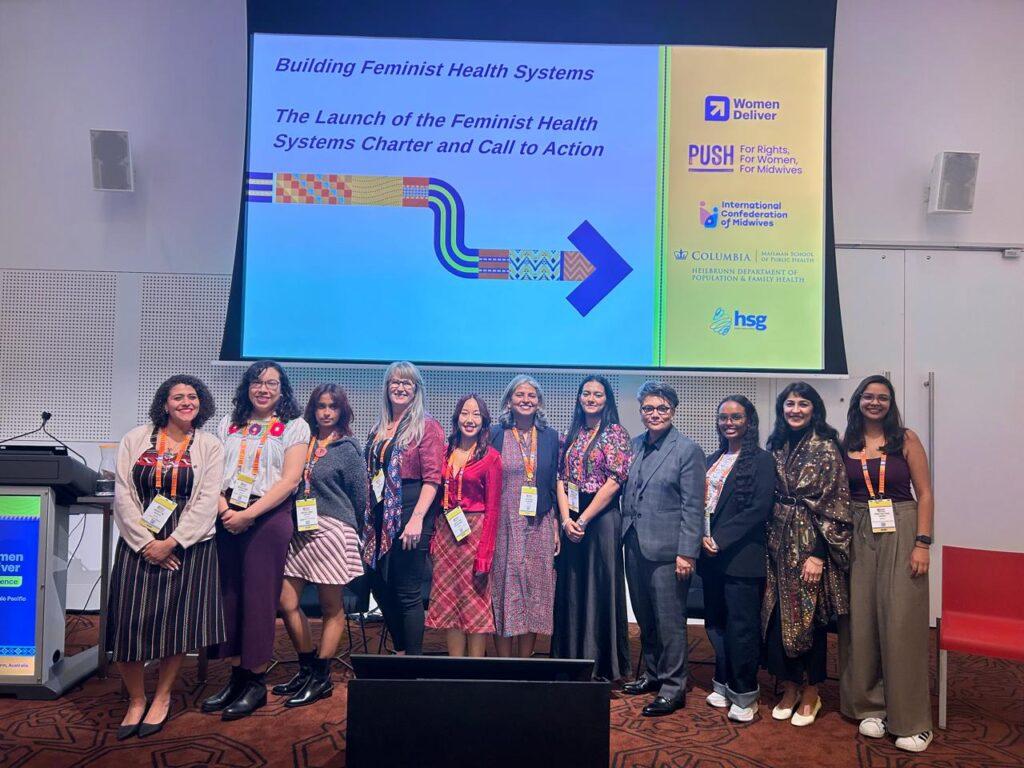




The recent Women Deliver Conference 2026 in Melbourne marked an important moment for those working at the intersection of gender, health, and justice. With the launch of the Melbourne Declaration for Gender Equality and the Feminist Health Systems Charter, with the associated calls to Action, there is now a clearer path for what feminist health systems could look like and what is required to build them.
This moment matters because it reflects both progress and unfinished business. Three decades ago, the Beijing Declaration and Platform for Action affirmed that women’s rights are human rights and placed responsibility on States to address structural inequalities. Yet many of the commitments made in Beijing remain only partially realized. Health systems around the world continue to reproduce inequality, often through policy choices that prioritize markets over public goods and efficiency over equity.
For too long, health systems have been thought of as neutral. They are not. They reflect power, priorities, and choices. Addressing this, the Melbourne Declaration calls for a shift in how gender equality is framed and advanced. It places responsibility back on States, calls for stronger public accountability, and highlights the need for collective voice and solidarity. This is an important shift at a time when the burden for change is often placed on individuals and communities, without the structural support or resources present to address deeply rooted inequities.
The Feminist Health Systems Charter brings this vision directly into the health sector. It was co-developed by Women Deliver, the PUSH Campaign hosted by the International Confederation of Midwives, Columbia University’s Mailman School of Public Health, and the Gender and Health Systems Thematic Working Group (TWG) of Health Systems Global (HSG), and informed by community consultation and peer review.
At its core are twelve feminist principles that articulate what it means to build health systems grounded in the right to health across life-course. These principles address intersectionality and the structural determinants of health; anti‑colonial and decolonial approaches; respectful, person‑centered care; disability justice; mental health; health systems in conflict and crisis; the rights of migrants and displaced communities; climate and environmental justice; health workforce equity; and universal health coverage and equitable financing.
Health system failures are not inevitable; they are the result of long-standing neglect and unequal systems. Women, girls, and gender-diverse people continue to face barriers in accessing care, as do those living in poverty, remote areas, and with disabilities. The Charter therefore emphasizes transparency, participatory governance, and accountability to communities, particularly those who experience the greatest barriers to care.
A feminist approach to health systems asks us to see these connections. It asks us to design systems that respond to real lives, not ideal conditions. It means moving away from one-size-fits-all models and towards systems that are flexible, inclusive, and rooted in dignity, autonomy, and care. It places value on care as a public good and calls for investment in public systems that are universally accessible.
Interrogations of power are also essential. Too often, decisions about health are made without the voices of those most affected. The Charter is clear that this must change. Communities, health workers, and especially those who face the greatest barriers must be central to decision-making. This is not just about consultation. It is about shared power.
The Charter is designed primarily as an advocacy and accountability tool. It translates States’ existing obligations under international human rights law into concrete principles for how health systems should be designed, governed, financed, delivered, and held accountable. Sitting alongside the Melbourne Declaration, it applies the Declaration’s calls for rebalancing the gender equality ecosystem around State responsibility and public accountability directly to health systems. Adaptable across contexts, governments can use it to guide policy and reform, researchers can use it to shape questions and methods and civil society and movements can use it as a tool for advocacy. It offers a shared language, rooted in evidence and human rights charters, that enables different actors to build on together.
Though the work ahead will not be easy, there are reasons for hope. Health systems cannot claim to serve everyone if they continue to exclude so many. A feminist approach is not an add-on but essential to building systems that are fair, inclusive, and effective. The energy in Melbourne showed that there is growing momentum for change. For the Gender and Health Systems and Ethics and Justice TWGs of HSG, this moment is an opportunity to collaboratively hold health systems accountable. Even beyond the HSG community, there is a shared understanding that health systems must do better, and that gender justice must be at the center of this effort. The Charter and the Declaration together offer a path forward. The question now is whether we are ready to follow it.