
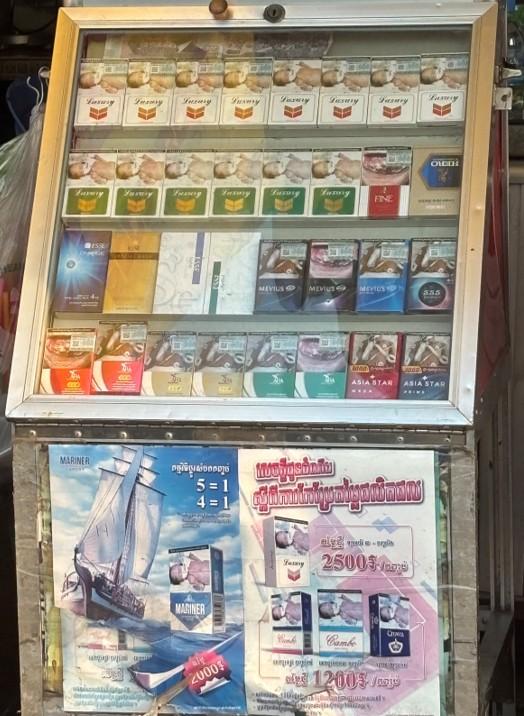



Four industries kill on a population scale. The rules that make their products cheap, available and advertised remain the least measured part of the epidemic, certainly in LMICs like Cambodia.
Tobacco, ultra-processed food, fossil fuels and alcohol account for 19 million deaths a year: 34% of all deaths (56 million), and 41% of deaths from noncommunicable diseases (NCDs) (42 million). The 2023 Lancet Series on Commercial Determinants of Health notes that these industries extract income from, and externalise harms to, low- and middle-income countries (LMICs).
Commercial determinants are “the systems, practices, and pathways through which commercial actors drive health and equity”. The Lancet Series sets out a six-level model of these, from upstream to downstream: (1) the political and economic system; (2) regulatory approaches and upstream policies; (3) sectoral public policies; (4) physical and socioeconomic environments; (5) the final routes to health effects — consumption, exposure, access to beneficial products, injury; and (6) the resulting ill health and inequities. NCD research has concentrated almost entirely on levels 5 and 6, putting the weight on consumers. Levels 1 to 3 — where commercial actors shape the rules that make a product cheap, available and advertised — remain the least examined. Routine surveillance is not built to detect them. We aim to help address this gap via ongoing research. Below you find some preliminary findings from Cambodia on tobacco, alcohol and food.
Since 2025, the IHP ResNet network, led by the Institute of Tropical Medicine, Antwerp, has studied whether policy matches commercial exposure and NCD prevalence in Cambodia, Benin, Mozambique and Ghana.
Surveillance needs two kinds of data: NCD outcomes (diabetes, hypertension, obesity and overweight, liver and lung cancers) and commercial exposures — how much tobacco, alcohol and ultra-processed food is sold and used.
The study then pairs surveillance with policy scoring across four tools:
Each indicator is scored for whether a policy exists as well as for the extent of implementation.
In Cambodia, data from the STEPS 2023 survey were recoded to match STEPS 2010 (using age groups 25-64). Over the past 15 years or so, diabetes rose from 2.9% to 7.6%, high blood pressure from 11.2% to 19.9%, overweight (BMI ≥25) from 15.4% to 22.9%, and obesity from 1.9% to 4.7%. So quite some trends went in the wrong direction.
What did our surveillance/policy scoring reveal?
Tobacco: strongest statute
All MPOWER and Tobacco Interference Index indicators (17) could be scored in Cambodia. Current smoking fell from 19.5% in 2011 to 16.9% in 2014 (ages 15+), but youth use (ages 13–15) rose from 2.4% in 2016 to 3.5% in 2022.
The 2025 WHO profile ranks Cambodia very well for monitoring, smoke-free legislation, pack warnings and direct advertising bans. Pictorial warnings cover 55% of the packages under Sub-Decree 149 and Prakas 013 SBK (Prakas is a regulation issued by a Cambodian ministry). The 2015 Law on Tobacco Control and Sub-Decree 43 ban smoking in health facilities, schools, offices and transport; the situation in restaurants and pubs remains more ambiguous.
Taxation is the weak point: making up only 26.45% of the retail price, against a 75% WHO benchmark. Between 2008 and 2024, cigarettes became 58% more affordable.
The 2025 Tobacco industry interference index scores Cambodia 70 out of 100. As mentioned above, a higher score means more interference from the industry. The Ministry of Education, Youth and Sport Circular No. 10 AYK.SNN (17 February 2021) bans tobacco-industry partnerships in schools, and Circular No. 003/23 SN (27 December 2023) does the same at sports venues. However, no equivalent rule binding the rest of government has been found.
Alcohol: a legal vacuum against a spike in consumption
In Cambodia, only 5 of 15 alcohol measures could be scored from public documents. Half of adults drank in the past 30 days; 24.5% reported heavy episodic drinking. Beer accounts for 96% of recorded volume (according to a 2025 paper by the Southeast Asia Public Policy Institute and the Asian Vision Institute, prepared with support from the Asia Pacific International Wine and Spirits Association). Unrecorded homemade and smuggled supply is about half of all consumption.
A 2015 draft Law on Alcohol Control was never enacted. There is no national limit on hours of sale, no alcohol-specific licence, and no minimum age for buying alcohol. To some extent, Prakas 084 regulates alcohol advertising (with among others, a two-hour television and radio blackout between 6 and 8 pm). Taxation is 30% on beer and 35% on other alcohol (Law on Taxation; Sub-Decree 122), plus a 5% public lighting tax (Sub-Decree 286). The blood-alcohol limit is 0.05 g/dL under the Law on Road Traffic; national random testing is not carried out.
Food: weak labels, lack of public info
Out of 53 Food-EPI indicators, 22 could be scored in Cambodia. Prakas 0059 makes nutrition labels voluntary. Sub-Decree 232 has no food-marketing clause, so front-of-pack labels, menu labels and restrictions on marketing to children are absent. Sales, marketing spend, the number of outlets and affordability are not available in any public source.
Overall, of 85 policy indicators, 44 could be scored, meaning that no related legislation could be found for the other 41 indicators.
Challenges and way forward
We see at least two challenges.
The tobacco treaty shows a proper law is possible, including in an LMIC country like Cambodia. The same rules cannot simply be copied for alcohol or food. What can be copied is the measurement: add sales, advertising and affordability to routine surveys; report data on prices and taxation together and track inflation-adjusted prices to determine whether the products have become cheaper over time. Score the law and its enforcement separately, while stating what could not be checked.
Work continues in Benin, Mozambique and Ghana. Stay tuned!
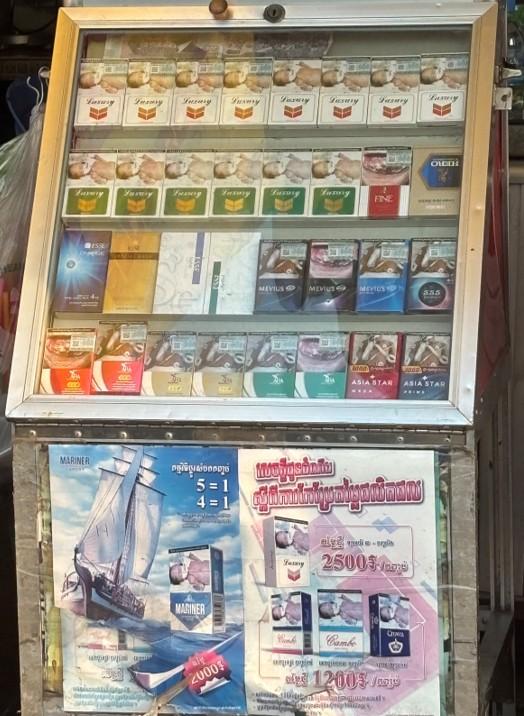
A cigarette stall in Phnom Penh – not all cigarette packaging complies with the law
(picture via Grace Ku)