
No society achieves genuine progress when a significant portion of its people faces systematic exclusion from essential services. As someone previously involved in implementing social health insurance at the state level in Abia, (South-East) Nigeria, I have seen how national UHC frameworks — often shaped by donor priorities — collapse at the point of delivery for persons with disabilities. True Universal Health Coverage (UHC) must measure what matters: whether every citizen[KD1] [AS2] , regardless of ability, can access quality care without financial ruin or indignity. In spite of the current drive towards more health sovereignty, reforms still don’t pay enough attention to disability-inclusive UHC.
UHC and disability
The WHO reports the global UHC Service Coverage Index rose from 54 in 2000 to 71 in 2023. The African region, in spite of some progress, lags badly, however. Many countries in the region have launched insurance schemes and primary healthcare reforms, yet coverage remains uneven. Nigeria is no exception. And nowhere more so than for persons with disabilities.
According to a 2022 WHO report, persons with disabilities make up around 15-16% (1.3 billion) of the global population, with higher rates in low- and middle-income countries. Persons with disabilities often have a need for more rehabilitation, assistive devices, and mental health support, plus extra costs for transport and personal assistance. Disability-specific public spending in much of Africa is below 0.5% of GDP, while ODA[KD3] [AS4] is often fragmented and tends to benefit foreign suppliers rather than building local capacity—with the notable exception of UK FCDO funding, which mandates disability inclusion across all projects.
A key problem is that standard UHC metrics rarely disaggregate by disability. Governments and donors claim “progress,” while a deaf woman in rural Nigeria cannot register for care due to missing sign language services, or someone with mobility impairment stays homebound because accessible transport is not covered or is unaffordable. Putting some figures on this, in Nigeria, the National Health Insurance Scheme (NHIA) nominally covers chronically ill and disabled persons, but overall enrolment stays below 10%, with actual access for disabled citizens far lower due to physical, attitudinal, and financial barriers.
A vicious conflict/poverty/governance-disability cycle, and let’s not get into road safety
Moreover, a glaring contradiction undermines Africa’s health talk: while we decry disability, conflict, poverty, and poor governance, we keep creating more of it. Wars and insurgencies maim civilians; poverty, malnutrition, and weak maternal care produce lifelong impairments. Resources flow to emergency aid and foreign contractors instead of peace-building and resilient local systems.
(Lack of) road safety is another key issue in the Africa region, with unfortunately major repercussions for disability. While road accidents get more and more attention at the UN level — including through the ongoing Second Decade of Action for Road Safety (2021–2030) and related global campaigns — sustainable, locally-led prevention and response systems remain underfunded.
Three failures
Overall, three major gaps can be discerned.
1. Data and Measurement Deficits: National health systems rarely collect or report disability-disaggregated data. Global metrics, on the other hand, tend to incentivize box-ticking over reality, while data extraction by external actors raises sovereignty concerns.
2. Financing Priorities and Dependency: Budgets favor donor-visible projects over sustained accessibility investments. Domestic revenue leaks through waste, corruption, and elite priorities. Over-reliance on unpredictable ODA distorts agendas, often prioritizing import-dependent solutions over local manufacturing of assistive devices and drugs.
3. Implementation Gaps at Sub-National Level: National laws exist, but translation to communities fails due to untrained workers, inaccessible facilities, and benefit packages ignoring rehabilitation. Elite capture and weak decentralization compound this.
The cost of a lack of inclusion is immense: higher morbidity, lost productivity, and intergenerational poverty. Exclusion is not just inequitable—it weakens national human capital. Investing in inclusion is thus smart economics and a matter of sovereignty. As voices like Peter Obi, Alex Otti and David Anyaele have stressed, developing our people requires policies that leave no one behind.
Policy recommendations
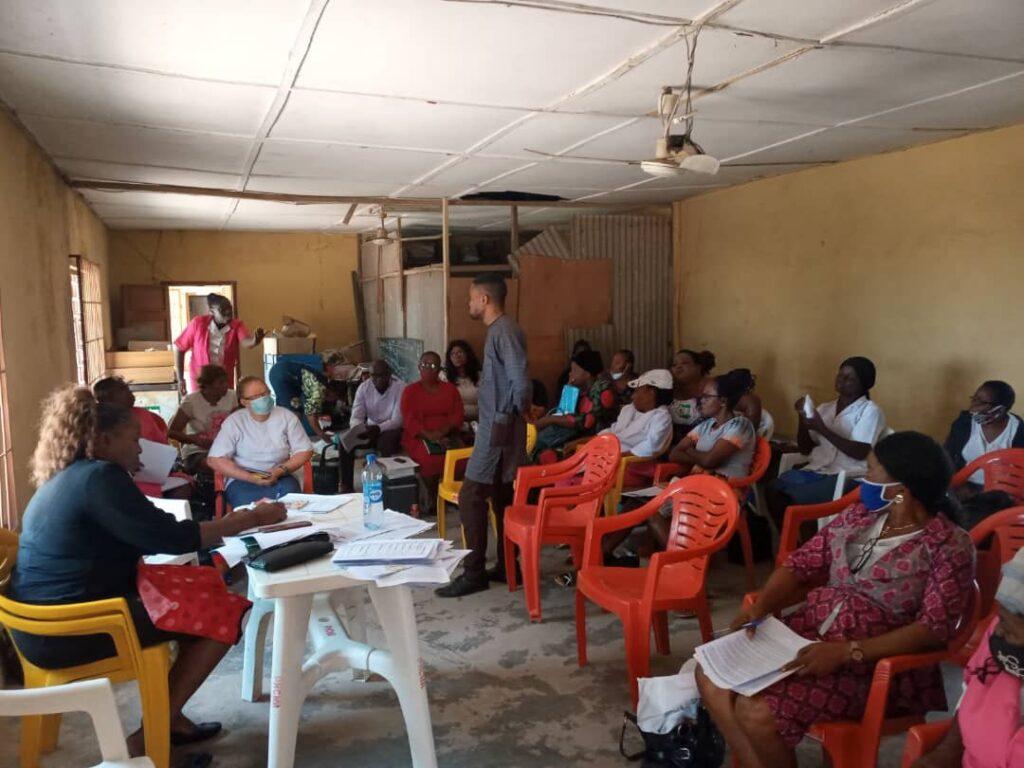
In Abia State, our Social Health Insurance Agency has integrated disability tracking. Community monitoring reveals higher dropout rates among disabled enrollees due to non-medical costs. Persons with Disabilities do not benefit maximally from laws, unless their needs are fully considered from the design stages onwards. We noticed the same in Abia.
Building on this, genuine inclusion in countries like Nigeria and others in the African region requires a whole package of policy measures:
– Disability data in all UHC reporting and monitoring. It all starts with measuring.
– In parallel, adopt universal design principles in health systems and infrastructure. It is often the inaccessible environment, rather than the impairment itself, that prevents people ‘outside the norm’ from fully participating
– Allocate at least 0.5% of GDP to disability benefits, protected and transparently tracked. Prioritise domestic revenue mobilisation.
– Make assistive devices, rehabilitation, and accessibility core entitlements. Promote local production to reduce import dependency. Expand targeted subsidies for the vulnerable, drawing from community-based models like in the Bokk Naa Cii project in Senegal.
– Train workers, embed Organization of Persons with Disabilities (OPDs) in governance, strengthen sub-national M&E and undertake a disability-inclusive audit of facilities and their services.
– Invest in peace and prudent fiscal management to stem new disabilities.
Disability-inclusive UHC will test whether Africa’s reforms truly deliver equity and sovereignty — or remain performative. As is the case for all issues, it all starts with measuring – and so there’s an urgent need to center disability as a core metric. But as is clear from the above, far more will be needed to get to a disability-inclusive society, including universal design, breaking the conflict-poverty-disability cycle, and tackling road safety. Only then, we move from firefighting to real progress. Africa has the talent and resources. What we need is leadership that is frugal, transparent, and uncompromising on leaving no one behind.