

Launched by the Honourable Prime Minister in 2023, India’s Viksit Bharat@2047 vision imagines a nation that is more productive and prosperous by 2047 – when the country completes 100 years of independence. Achieving this ambition will not only require investments in economic growth and infrastructure, but also in the people who will shape India’s future. Yet, somewhere between that ambition and the one-room homes of the urban poor lies a question India’s early childhood development agenda has not yet answered: who is actually available to raise the children being born in these cities?
It is not a rhetorical question.
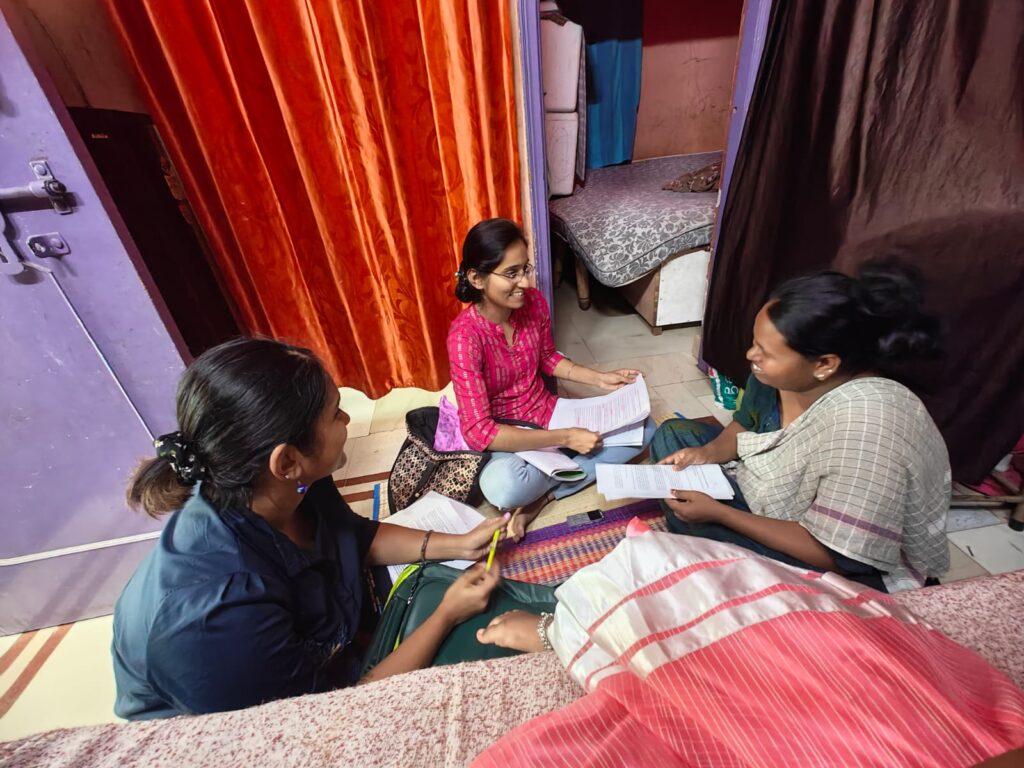
I have spent years researching caregiving in Bengaluru’s urban poor settlements and came to the following conclusion: caregiving constraints – particularly time poverty – shape what families can offer young children in ways that nutrition programmes, Anganwadi visits, and preschool enrolment simply cannot. It’s about time we do something about it.
Early childhood caregiving: missing from urban development thinking
What really strikes me is how caregiving for young children remains largely absent from how we think about urban development. We routinely discuss housing, transport, water, and sanitation as essential infrastructure. Cities, however, also depend on ‘care infrastructure’. Rapidly urbanizing economies largely function because workers show up each day. But who enables that work by caring for their young children?
This matters even more because the first years of life are foundational. Early childhood development depends not only on nutrition and healthcare but also on responsive relationships, stimulation, play, and emotional security. When caregivers are exhausted, isolated, or stretched across competing demands, the quality of those interactions inevitably suffers. Yet, policy often takes for granted the time and support it requires.
Many early childhood programmes implicitly assume a caregiver who is available for home visits, able to participate in parenting activities, and supported by family networks. Yet the caregiver raising a young child in an urban informal settlement may be managing paid work, household responsibilities, and childcare with little support and limited time.
Indeed, most urban poor mothers cannot stay at home, not even temporarily. More than 90% of India’s workforce is employed in the informal sector, and urban poor women are concentrated in domestic work, street vending, and construction labour. These jobs offer little flexibility, no paid leave, and no childcare support. Returning to work soon after childbirth is often an economic necessity rather than a choice.
For some mothers, however, the pressure runs in the opposite direction. Without anyone to leave the child with, they cannot work at all. Household incomes fall, economic vulnerability deepens, and the caregiver is left isolated, stretched, unsupported to provide alone what young children need most.
Either way, the caregiver is trapped. Unable to stay home, or unable to leave home.
Where are the fathers?
But there is a second person in this story who almost never appears in it: the father.
India’s early childhood programmes are addressed almost entirely to mothers. From home visits and supplementary nutrition to parenting counselling under POSHAN 2.0, all assume the mother’s participation. Fathers in urban poor households face similar constraints, with long commutes and insecure work, while the absence of paternity entitlements often excludes them from their children’s early years. This is not by choice, but circumstance. As policy continues to treat fathers primarily as earners and mothers primarily as caregivers, this division neither reflects nor serves the realities of urban poor family life.
A lack of urban care infrastructure
What makes this doubly consequential is the collapse of the buffer that once absorbed both parents’ absence. In villages, care was often distributed across grandmothers, aunts, and even neighbours. But migration to cities slowly eroded those support systems. What was once shared across a household and community now typically falls on one or two adults.
When caregivers are unable to fulfil the demands, consequences are visible, with older children taking on caregiving responsibilities, packaged foods replacing meals that require time to prepare, and screens becoming substitutes for interaction and play. These are not failures of parenting. They are responses to a shortage of care. And no, not simply a shortage of childcare, but a shortage of the care infrastructure on which families depend.
Urban care cannot wait until 2047!
Koosina mane, a gender-responsive public service model by Government of Karnataka, demonstrated that childcare anchored to where women work, can generate real uptake. Going beyond Karnataka, the Palna scheme under Mission Shakti with coverage across the country for day-care facilities for children aged from 6 months to 6 years, also represents an important step towards recognising childcare as ‘infrastructure’ rather than welfare. Yet Koosina Mane has no urban equivalent, and neither initiative adequately addresses the realities of informal work, or fathers as caregivers.
Viksit Bharat 2047 has set an ambitious human capital agenda, but many children who will be twenty-one in 2047 are being born today in a slum, to parents working without contracts, without kin nearby, and often without a policy framework that considers both parents as potential caregivers. Viksit Bharat rightly asks what kind of workforce India will have in 2047, but the more urgent question is who will care for that blossoming workforce in 2026. Until policy addresses the chronic shortage of urban care, India’s human capital ambitions will continue to rest on caregiving arrangements that no longer exist.