
Traditionally, medical neutrality has been taken for granted: while remaining devastating for populations and individuals, combat and weapon attacks would stop in front of a hospital, a health centre or an ambulance. Health care facilities and vehicles were ‘bubbles of humanity’ in the midst of violence and inhumanity. But in the last decade, we have been witnessing an escalation of deadly attacks on healthcare providers and services, more and more carried out on purpose moreover. The “growing violations of medical neutrality in conflict zones worldwide — with Gaza, over the past twenty months, standing as a devastating example” are revolting for those who believe in the sanctity of each and every human life. And they are revolting for all of us who believe in health as a human right, and work towards achieving equal chances at a healthy life for all.
As healthcare workers, health researchers, health policy-makers and health advocates, we cannot ignore the attacks on health services that happen on a near daily basis in Gaza, nor the ones occurring in other – mediatised or forgotten – crises in Ukraine, Yemen, Sudan, Afghanistan, Syria and elsewhere. We cannot ignore them, because we are human, and because they violate the ultimate goal of our work, which is building health for all and equity in health.
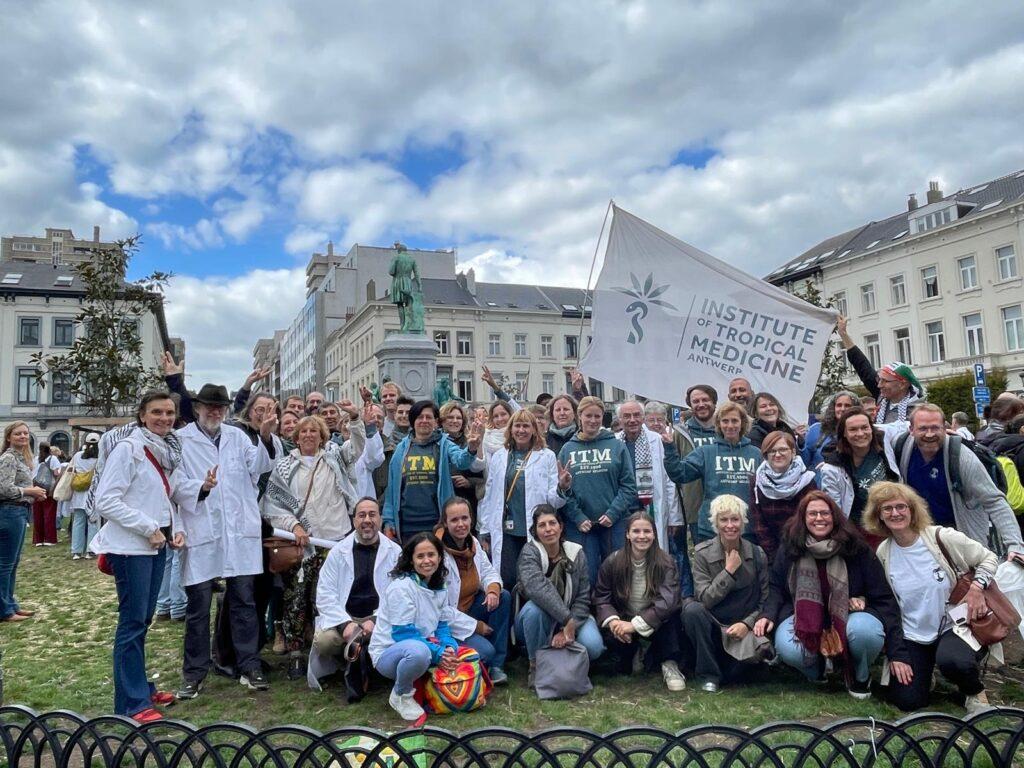
This is why on Monday 22nd September, a diverse group of colleagues from the three departments of ITM joined the international demonstration in front of the European Parliament, organized by the promotors of Medics On The Move For What Matters. Our voices and our silence joined those of colleagues from medical humanitarian organizations, medical associations, faculties of medicine, and university hospitals, to call on European institutions to act to guarantee the right to receive and provide healthcare. We asked the European institutions to take concrete measures to protect the life of healthcare workers and patients, as per Geneva Conventions. We asked them to defend the free passage of patients, medical supplies, and healthcare workers – even in besieged or occupied territories.
It was important to stand up publicly, together, for our values and in solidarity. But it will be equally important to show solidarity through our acts and actions, including by prioritizing research projects that aim to document barriers to accessing health care and improve health outcomes in conflict areas.