

“For he who has health has hope; and he who has hope, has everything.”
– Owen Arthur
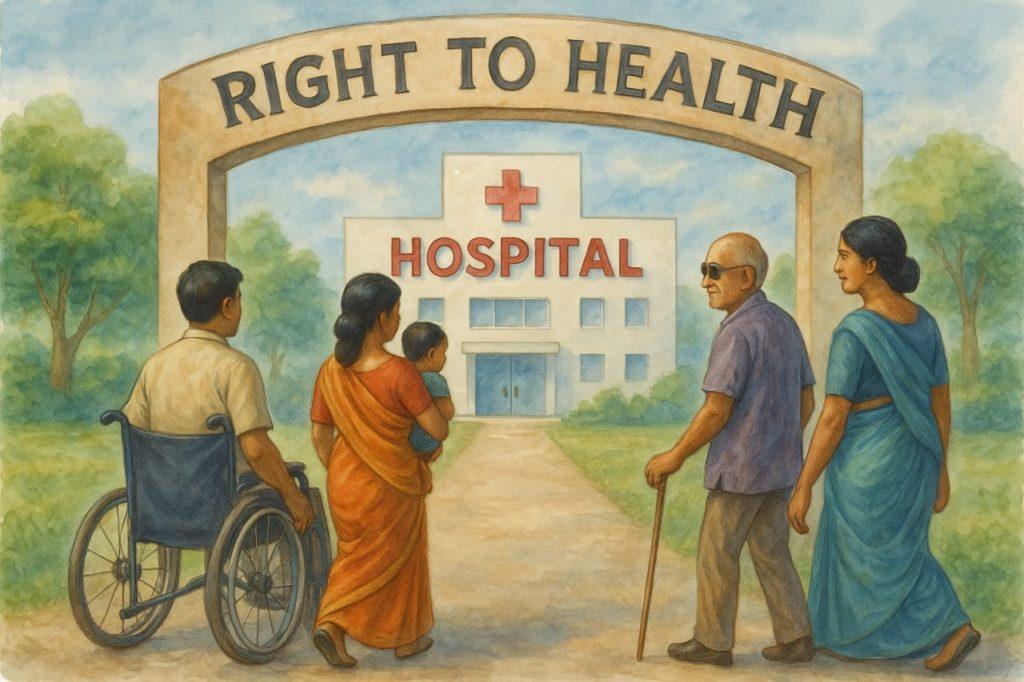
The preceded quotation by Owen Arthur, captures the intrinsic link between health and a person’s potential. It highlights health not merely as the absence of disease but as a foundational pillar for a fulfilling and productive life. Internationally, this vision is echoed in several frameworks that aim to ensure all individuals can live to their fullest without being constrained by health disparities or financial hardship. However, the recognition of health as a right in global declarations and constitutional provisions often stands in sharp contrast to lived realities, including in our country- India.
International frameworks & India’s constitution on the right to health
Many international frameworks recognize health as a fundamental human right. The right to health was first articulated in the WHO Constitution (1946), which states: “the enjoyment of the highest attainable standard of health is one of the fundamental rights of every human being.” Similarly, Article 12 of the International Covenant on Economic, Social, and Cultural Rights specifically outlines the right to health.
According to the WHO Council on the Economics of Health for All, at least 140 countries have enshrined health as a right in their constitutions. India has also made explicit commitments in this regard. As a signatory to Article 25 of the United Nations’ Universal Declaration of Human Rights (1948) and through Article 21 of the Indian Constitution, India affirms the fundamental right to life and personal liberty. Furthermore, the Directive Principles of State Policy (DPSP) obligate the state to uphold the right to health through Articles 38, 39, 42, 43, and 47.
Health rights in practice: A stark reality
The recognition of health as a right in global declarations and constitutional provisions often stands in sharp contrast to lived realities, however. Despite all these lofty commitments, progress on the ground remains insufficient in far too many countries. For instance, in 2021, over half of the world’s population still lacked access to essential healthcare services.
Gaps in coverage are not limited to infrastructure and availability alone; they are often compounded by discrimination and systemic inequities. These become especially visible during times of crisis. The COVID-19 pandemic, for example, laid bare deep-seated inequalities in India’s healthcare system. A survey by Oxfam India on vaccination revealed that nearly one in four Indians experienced discrimination by medical professionals based on caste or religion. The findings showed that one-third of Muslims, more than 20% of Dalits and Adivasis, and 30% of all respondents reported being discriminated against in hospitals or by healthcare personnel due to their identity.
This raises a critical question: Are individuals being actively denied care, or are they deterred from seeking it due to systemic inequities? Such questions cannot be answered by looking at individual incidents alone; they are rooted in structural biases that shape who receives care and who does not.
An analogy and a tale
Dr. Camara Jones’s cliff analogy illustrates how health inequities accumulate across multiple levels. She lists three dimensions of health intervention to help people who are falling off of the cliff of good health: providing health services, addressing the social determinants of health, and addressing the social determinants of equity. At the base of the cliff, disparities appear as differences in the quality of care received by those already injured. On the cliff’s slope, inequities emerge through differences in access to preventive and curative services. Most profoundly, some communities are pushed closer to the edge in the first place because of differences in underlying exposures and opportunities that make them more vulnerable to illness. Together, these layers show that health disparities do not arise randomly but are structured by the environments in which people live.
But who decides who stands near the cliff’s edge and who enjoys safety further inland? The Gardener’s Tale offers deeper insight. Imagine a gardener with two flower boxes: one filled with fertile soil and the other with rocky soil. Favoring red flowers, she plants red seeds in the fertile soil and pink seeds in the rocky soil. Over time, the red flowers flourish while the pink ones struggle to survive. This mirrors India’s healthcare reality, where privileged groups thrive in “fertile soil” with abundant opportunities and resources, while marginalized communities are pushed closer to the cliff, left to grow in “rocky soil” marked by neglect, systemic bias, and limited access to care. Inequities are therefore not accidental but cultivated: they arise because the “gardener” (i.e. society and health systems in this context) nurtures some soils while abandoning others.
A stark example of this “rocky soil” is women’s lack of autonomy in healthcare. Anecdotes from hospitals reveal how decisions about female patients’ care are often deferred to male relatives, even when female family members are present. In Guwahati, for instance, a doctor shared how a man was chosen over women in the household to receive updates about a patient’s prognosis. Such practices reflect ingrained social norms that strip women of their rights and reduce them to passive recipients rather than active claimants of their right to health. As one medical professional remarked, “Indian women do not even make their own healthcare decisions”. True equity cannot be realized without addressing this gendered imbalance in decision-making power.
Promising signs of progress
While inequities remain stark, there are signs of progress.
Financial protection schemes such as Rajasthan’s Mukhyamantri Chiranjeevi Swasthya Bima Yojana (formerly Chiranjeevi Health Insurance cards) are designed to reduce catastrophic out-of-pocket expenditure. Other states have pioneered similar efforts: Tamil Nadu’s Chief Minister’s Comprehensive Health Insurance Scheme, Andhra Pradesh and Telangana’s Aarogyasri programme have all expanded financial protection for vulnerable groups. At the national level, the Ayushman Bharat–Pradhan Mantri Jan Arogya Yojana (PM-JAY) represents a significant attempt to extend coverage to over 500 million people.
These schemes are primarily directed towards the vulnerable and lesser-privileged sections of society, providing them with financial relief from major healthcare expenses. Yet, equity in health is not guaranteed by financial coverage alone. Low levels of awareness, social and cultural barriers, discrimination, and the uneven distribution of health services continue to limit the ability of many intended beneficiaries to access and fully utilize these schemes. As a result, financial protection does not automatically translate into equitable healthcare access or outcomes.
Another sign of progress: Rajasthan’s Right to Health Bill, which seeks to legally enshrine health as a fundamental right at the state level. The bill is an important first step in codifying health as a legal right. Yet, its impact has been blunted by resistance from private providers, vague definitions of “emergency,” and the lack of a clear reimbursement mechanism. Following protests, the government exempted most small hospitals effectively removing nearly 98% of private entities from its ambit which risks making the law more symbolic than transformative. However, even in its weakened form, the Bill is significant for placing health care squarely within the rights discourse and for opening a political and legal space where demands for stronger accountability can grow. Its real impact on the ground will depend on effective implementation, enforcement, and addressing structural inequities in access and service delivery.
Overcoming misconceptions and way forward
Debates around Rajasthan’s Bill also reflect a broader challenge that the recognition of health as a human right is often undermined by misconceptions that it is too costly, that it means only medical care, or that it is merely symbolic. Whereas in fact, health as a human right enables fairer allocation, embraces social determinants, and empowers accountability. In other words, recognizing health as a right is not a lofty ideal but a moral and practical pathway to equity, dignity, and access for all.
The 2024 WHO theme, “My Health, My Right”, underscored health as a fundamental entitlement. Its promise is still far from realized in our country, however. In 2025, with the theme “Healthy Beginnings, Hopeful Futures” and in the years ahead, India must continue with this unfinished agenda. So that one day the right to health is not just a declaration but becomes a lived reality for every citizen.