
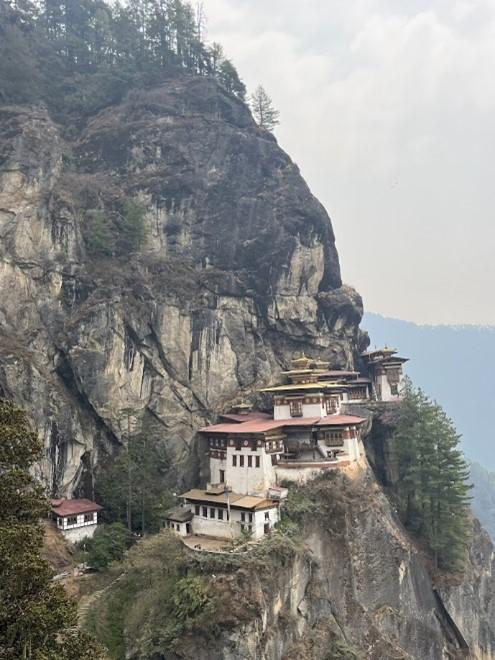

Tucked away in the Eastern Himalayas between China and India, Bhutan is quietly leading by example in areas the global health community continues to debate – climate resilience, commercial and social determinants of health, and health promotion. Unlike louder voices on international platforms, Bhutan rarely makes headlines, but it certainly deserves recognition for its steady, principled approach to global health challenges.
I had the privilege of visiting Bhutan recently for a regional workshop on antimicrobial resistance (AMR) surveillance and data visualization, organized by Fleming Fund Antimicrobial Resistance and One Health South Asia (AMROH SA). Flying into Paro, one of the world’s most dangerous airports, with its dramatic descent between Himalayan peaks, was a fitting introduction to a country as unique as it is inspiring.
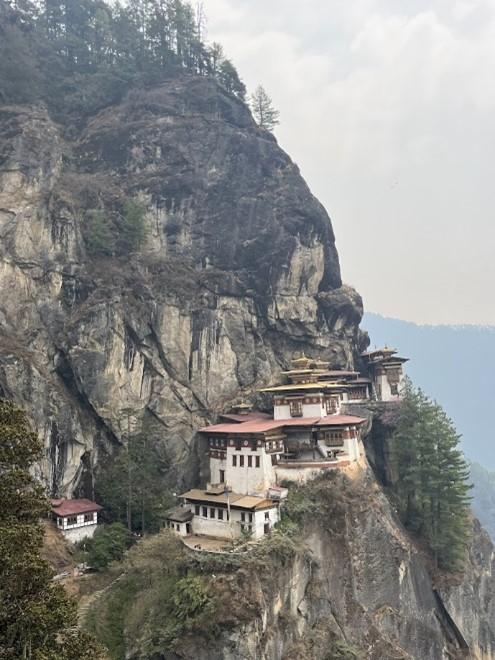
Paro Taktsang (a sacred Tiger’s Nest Bhutan monastery) located in Paro, Bhutan
What struck me most was Bhutan’s integrated vision for health, happiness, and sustainability. Bhutan is the only country in the world that uses Gross National Happiness (GNH) as a development metric alongside GDP. Rooted in Buddhist philosophy, GNH emphasizes a balance between material progress and mental, cultural, and spiritual well-being. Every five years, Bhutan conducts a national happiness survey. Recent results show increasing GNH, driven by better health, improved living standards, and active cultural participation. This aligns beautifully with the WHO definition of health as “a complete state of physical, mental, and social well-being and not merely the absence of disease or infirmity”.
From a global health lens, Bhutan is addressing commercial determinants of health better than most. The country has no KFC or MacDonald fast-food chains, no billboards, and limited multinational influence. Television arrived only in the early 2000s. Most shops are small and locally owned. In 2010, Bhutan banned tobacco sales and imposed a 100% tax on imports for personal use. Healthcare and education are guaranteed by the Constitution, which mandates free access to both modern and traditional medical services.
On the One Health and Planetary Health part, Bhutan’s example is extraordinary. In 2021, following a royal decree, the country launched its most ambitious Nationwide Dog Population Management and Rabies Control Programme to vaccinate and sterilize all free-roaming dogs. Within two years, Bhutan became the first country in the world to achieve 100% sterilization of its free-roaming dog population. This is a true One Health success integrating animal welfare, public health, and community action.
During our workshop, we also learned that Bhutan is effectively combatting AMR well by strictly regulating the use of antimicrobials in food production. As a result, resistance levels are significantly lower compared to neighboring countries such as India, Nepal and China.
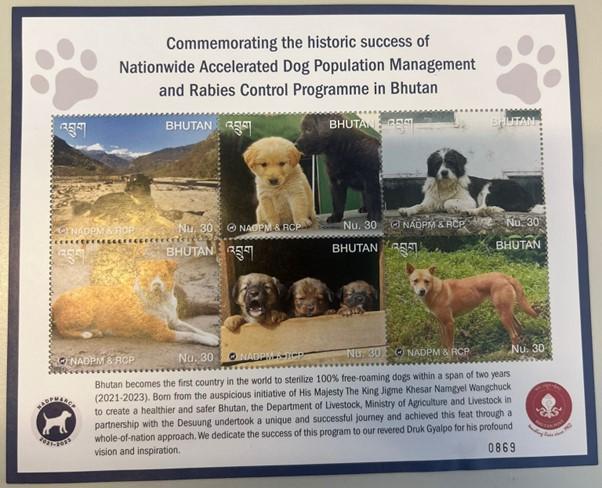
The exclusive post stamps from the rabies control program in Bhutan
Environmentally, Bhutan is the world’s only carbon-negative nation. Over 70% of its land is covered in forest, and the Constitution mandates that at least 60% remain forested at all times. The country absorbs more carbon than it emits, thanks to strong conservation laws and hydropower-based clean energy.
Looking ahead, Bhutan is developing Gelephu Mindfulness City (GMC), a special administrative region aiming to fuse economic development with ecology and mindfulness. Its vision includes five “zero” goals: zero plastic, zero malaria, zero rabies, zero drug use, and zero crime. Despite being small and landlocked, Bhutan has achieved what many wealthier nations struggle to: aligning development with well-being and planetary stewardship.
Nevertheless, Bhutan also faces its own set of challenges. The country is currently experiencing significant emigration and brain drain, particularly among young professionals seeking better job opportunities and higher incomes abroad. Bhutan remains resource-limited and is in need of both human and technical resources. With the development of this new mindfulness city, we hope that Bhutanese living abroad, as well as foreigners, will contribute to sustaining and enriching a distinct Bhutanese identity.
Really insightful, thank you for sharing your experience in Bhutan.
Many thanks 🙂