
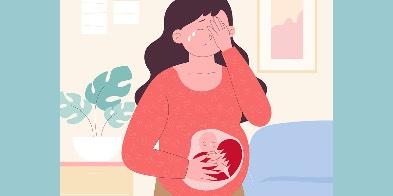

In India, motherhood is celebrated with devotion—songs are sung, blessings are showered, and a woman is often told she has been ‘reborn’ after giving birth. But what if, amid all the rituals and reverence, she is drowning in an invisible storm? What if, while the world rejoices in the arrival of new life, she is silently battling thoughts of despair, loneliness, and even death?
Perinatal anxiety and depression in the perinatal period are common, affecting an estimated 1 in 10 women in high-income countries (HICs) and even 1 in 5 in low- and middle-income countries (LMICs), indicating the importance of support for perinatal mental health globally.
In India, the situation is particularly concerning —an estimated 22% of Indian mothers suffer from postpartum depression, highlighting a pressing need for awareness, resources, and maternal mental health support.
Yet most “of these mothers” go unnoticed, “with their mental pain” dismissed as fleeting ‘baby blues.’ In many cases, the reality is far darker, however.
A silent epidemic
On its website, UNFPA India describes the case of a 33-year-old homemaker from Delhi. “Two weeks after giving birth, she found herself consumed by insomnia, negative thoughts, and paralyzing anxiety. She tried to tell her family, but they brushed it off as mere hormonal changes. It was only when she attempted suicide that her husband realized the urgency of the situation and took her to a therapist. “ She was diagnosed with perinatal depression—something she had never even heard of before.
She is far from alone. As reported in a Guardian article from a few years ago, another woman, just a month after childbirth, found herself torn between overwhelming love and an unexplainable urge to harm her baby. “There were moments when I adored my daughter,” she confessed, “and others when I tried to suffocate her with a pillow.” As mentioned in the article, this particular case is best understood as postpartum psychosis —a rare but severe mental health condition that affects approximately 0.1 percent of new mothers. Postpartum psychosis is a medical emergency characterized by hallucinations, delusions, confusion, and, in some cases, harmful thoughts toward the child. Mothers experiencing this condition often struggle to respond emotionally to their newborns and may feel detached, overwhelmed, or dangerously conflicted.
While arguably postpartum psychosis is rare, perinatal depression is anything but. And so these are not isolated incidents in my country – they are echoes of a crisis we refuse to acknowledge.
Cultural expectations vs. mental health
In a country where the divine image of a mother is deeply ingrained in culture, struggling with mental health is seen as a failure. A mother is expected to be self-sacrificing, endlessly nurturing, and resilient to all pain. If she speaks of exhaustion or sadness, she is weak. If she dares to say she is unhappy, she is ungrateful. This stigma forces many women to suffer in silence, afraid of being judged, dismissed, or deemed unfit as mothers.
National Health Policy, 2017 and Mental Healthcare Act, 2017, acknowledge mental health as a fundamental right but fail to specifically address perinatal mental health. While policies focus on children and the elderly, the mental well-being of mothers—the very foundation of family health—remains invisible. The consequences? Women suffer in silence, their struggles masked by the veneer of societal expectations.
Historical neglect of mental health of mothers
India has historically focused on reducing maternal and infant mortality. Arguably, this has led to significant progress in physical healthcare interventions. The focus on survival has overshadowed the importance of mental well-being, however.
The UNFPA India website also offers the example of a woman Usha Mandal, a 28-year-old mother from West Bengal, left to fend for herself. Denied therapy due to her caste, deprived of financial independence, and too depressed to seek medical care, she stopped attending pregnancy check-ups. Her malnourished body could not support her child, and she gave birth to a stillborn. In her grief, she revealed, “I wasn’t even sane enough to eat. The food given to me, I hid under my bed covers and then threw away when no one was around.”
There are many women like her, whose stories we never get to know.
Moreover, perinatal depression doesn’t just affect mothers, it affects generations. Studies show that children of mothers who experience depression are at higher risk for ADHD, conduct disorders, and emotional instability. It even affects newborns physically, leading to low birth weight, premature delivery, and placental insufficiency.
No, it’s not just ‘Baby Blues’
Some argue that new mothers naturally feel overwhelmed, that exhaustion and emotional shifts are a part of the process. They dismiss perinatal depression as an overreaction to temporary stress. But would we say the same if a diabetic patient’s symptoms were brushed aside as ‘just sugar fluctuations’?
The difference between ‘baby blues’ and perinatal depression is stark. ‘Baby blues’ refers to short-lived, mild mood swings, while perinatal depression is a clinical condition that can persist for months or even years if untreated. The consequences are dire, yet we choose to ignore them in favor of a convenient narrative that motherhood is always joyous, always fulfilling, and never terrifying.
More than time to listen to mothers’ silent cries
Every mother deserves to be heard, understood, and supported not just in her body but also in her mind. Because if we don’t listen to her silent cries today, we may only hear them when it’s too late.
And by then, the lullaby may have already faded into silence.