

“Nobody will believe this if I say it. A five-rupee medicine cost me an hour and a half.”
Recently, my elder aunt (muthamma) was admitted to Government Medical College, Wayanad, in Mananthavady, Kerala. As a family member accompanying her, I spent considerable time moving between hospital counters, laboratories, pharmacies and administrative offices, carrying prescriptions, investigation requests and documents requiring multiple authorisations. I am an MBA graduate. I can read and write, understand instructions and navigate administrative systems. I also have some familiarity with the hospital.
Yet, obtaining a medicine costing just ₹5 took approximately ninety minutes.
The experience left me physically exhausted and mentally frustrated. But something troubled me more than my own inconvenience. If accessing a simple medicine was this difficult for me, what happens to someone who cannot read or write? What about an elderly Adivasi (Indigenous communities of India) person unfamiliar with the hospital, or a woman accompanying a critically ill family member?
The process began with a doctor’s request for investigations. I had to approach the hospital promoter handling documentation and benefit-related procedures, produce documents including the ration card and hospital identification details, obtain the necessary endorsements and proceed to the billing counter. After waiting, another instruction would direct me elsewhere. Diagnostic investigations involved similar difficulties. After completing preliminary formalities and reaching the laboratory, I could discover that a particular test was unavailable. This required another endorsement, a visit to the superintendent’s office and additional paperwork before exploring alternative testing facilities. Obtaining medicines was equally complicated. When a prescribed medicine was unavailable at the medical college pharmacy, I had to obtain a non-availability endorsement and further administrative approval. The process could then involve visiting Karunya Pharmacy, HCL Surgical and Madonna Pharmacy, collecting further endorsements and returning to earlier offices for forms, signatures and photocopies. Even finding the medicine did not necessarily mean the paperwork was complete. Each counter appeared to have a separate responsibility. But for me, these separate procedures became one exhausting journey.
All this effort was required to obtain a medicine costing just ₹5.
Had I known where it was available, I might have purchased it directly. But what about a family that cannot afford even small expenses? More importantly, why should obtaining an entitled healthcare benefit depend on a person’s ability to navigate complicated procedures? As I reflected on the experience, I realised that the problem was much larger than the ninety minutes I had lost. When someone visits a hospital, especially accompanying a seriously ill relative, they are already experiencing uncertainty and anxiety. They come expecting treatment, guidance and reassurance. Instead, when every step requires another signature, seal or visit to a different counter, they may begin to feel that accessing care depends on their ability to satisfy the institution’s demands. This raises a deeper question about dignity.
For us, the ADIVASI communities, dignity is not simply about being treated politely. It is also about being recognised as people whose time, knowledge, circumstances and concerns deserve consideration.I could navigate the hospital partly because of my education. But education should never become the condition for experiencing dignity within a public institution. The difficulty is not that we, as Adivasi people, are unable to understand how healthcare systems function. Rather, it is that healthcare institutions often fail to recognise and respond to the realities of our lives. For many of us in Wayanad’s Adivasi communities, reaching a hospital is itself a difficult journey. Long before we arrive at the registration counter, we may already have struggled to arrange transportation, find money for travel, leave behind our daily work and wages, or find someone to accompany a sick family member. By the time we reach the hospital, we have already overcome several obstacles. Yet, instead of finding a system that understands our circumstances and helps us navigate care, we may encounter another set of difficulties. We are expected to understand and adjust to the hospital’s procedures, but how often do these institutions make an effort to understand and adjust to our lives?
Over the years, researchers, often from outside our Adivasi communities, have studied and documented how illness affects our livelihoods and places financial and social burdens on our families. Yet, these are realities we have lived with for generations. What we need is not simply more documentation of our difficulties, but meaningful recognition of our experiences when healthcare services are designed and delivered. Our concerns go beyond financial hardship. When we enter hospitals, we often encounter unfamiliar rules, language and procedures shaped by institutions in whose decisions we have had little voice. We want to be heard not merely as subjects of research, but as people whose knowledge, experiences and dignity matter.
We have our own identities, histories, knowledge, languages and ways of caring for one another. These are important parts of who we are. Yet, when we enter formal healthcare institutions, we sometimes feel that these aspects of our lives have little place in how we are understood or treated. We are expected to adjust ourselves to the institution, rather than the institution making an effort to understand us.
I do not believe that every difficult experience we encounter in a hospital is necessarily an act of discrimination. But I have come to realise that a procedure which appears simple to someone familiar with the system can become an enormous challenge for another person.
We are not asking for special treatment because we are Adivasi. We are asking for our circumstances to be understood, our voices to be heard and our dignity to be respected. For us, equal access to healthcare cannot simply mean that the same hospital doors are open to everyone. It must also mean that we can enter those doors with confidence, receive the care we need without unnecessary hardship, and feel that these public institutions belong to us as much as to anyone else.
What I experienced in Mananthavady made me reflect on a larger question. Are we, as Adivasi communities in Wayanad, alone in experiencing this distance between our lives and the institutions meant to serve us?
Across the world, Indigenous Peoples have raised similar concerns about whether healthcare institutions recognise their identities, respect their knowledge and listen to their voices. Our histories and circumstances may differ, but we share an important aspiration: to receive healthcare without having to compromise our identity, dignity or sense of belonging. Health systems are often evaluated by the services they provide, but they should also be assessed by how easy those services are to access. Reducing unnecessary administrative burdens, involving Indigenous communities in service design, and providing better navigation support for patients and caregivers are practical steps toward a more responsive health system.
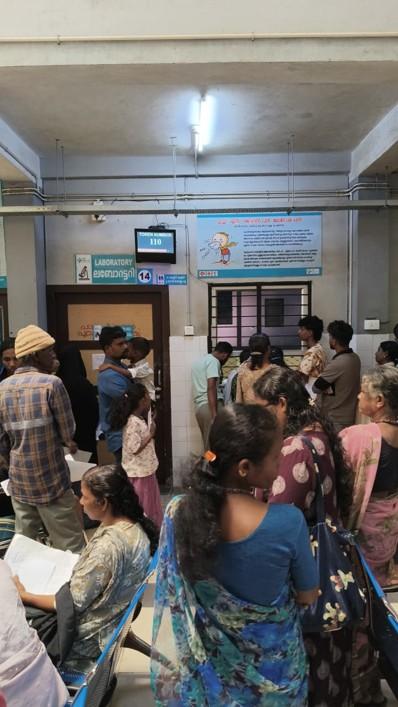
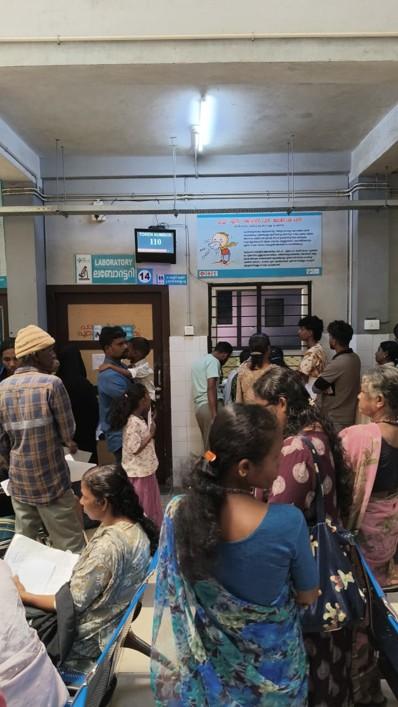
Adivasi patients and accompanying family members wait outside the laboratory at Government Medical College, Wayanad, Kerala. For Adivasi communities, navigating crowded hospital counters and administrative procedures can add to the difficulties of accessing hospitals (picture via authors).