
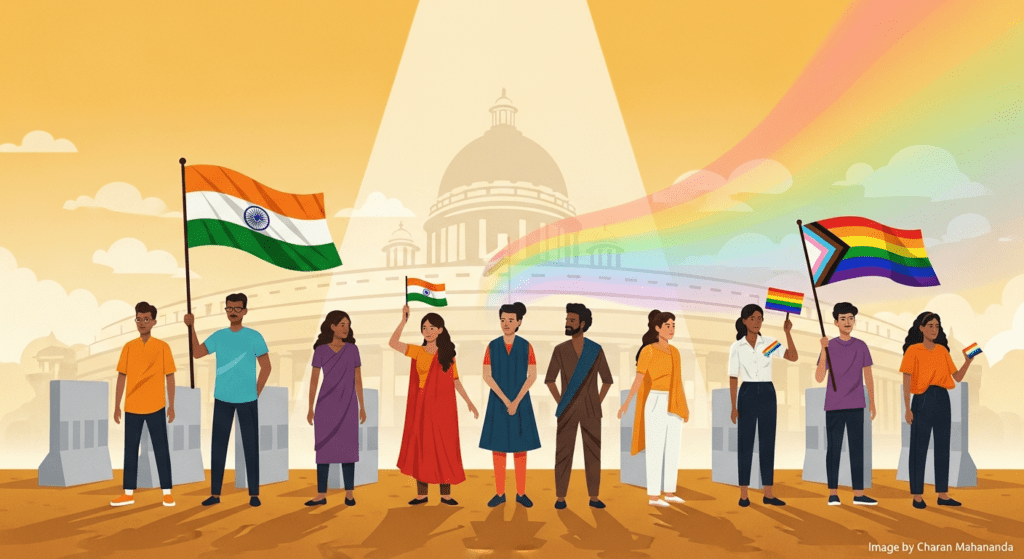

The International Day of Happiness (IDoH), celebrated on March 20, raises a simple question every year: what makes a society happy? This year’s theme of “caring and sharing” may seem to find its answer in individual acts of kindness. However, decades of global statistics tell a different story. It turns out that happiness is not something people create on their own. It is either built or withheld by societies. For millions of Lesbian, Gay, Bisexual, Transgender, Queer/Questioning, Intersex, Asexual and other (LGBTQIA+) people, society has consistently denied the conditions needed to be well. This article draws on the World Happiness Report, minority stress research, and India’s policy record to ask: what would an appropriate governance response look like?
Happiness is not an individualist thing but a structural one
The World Happiness Report has consistently found that being wealthy is not the main predictor of a country’s well-being: instead, social support, trust in the country’s institutions, and perceived corruption are. In contexts where institutions are trusted and accessible, researchers have observed what they call population-level happiness, which is a social outcome rather than an individual one. Conversely, in all institutions that exclude, discriminate, or ignore people, the opposite happens. Happiness diminishes, and it is often the marginalised who feel this contraction most acutely.
LGBTQIA+ communities make up about 10 per cent of any society. When one in ten faces structural barriers to well-being, legal recognition, safety, and belonging, the impact is not solely personal but also a public health issue. Public health research has extensively documented this process. The outcome of legal exclusion and social marginalisation is what researchers call ‘minority stress’, a form of ongoing psychological pressure that does not disappear with changing news cycles.
On 23 February 2026, the Netherlands appointed a gay man, Rob Jetten, as Prime Minister, as one of the first countries to do so. The very fact that he was elected shows institutional recognition; for example, the state does not just tolerate but also legitimises LGBTQIA+ identity. The Netherlands represents one end of this spectrum. India, with tens of millions of LGBTQIA+ citizens, even by conservative estimates, sits at the other end. In October 2023, India’s Supreme Court refused to extend marriage equality, leaving the issue to Parliament. In January 2025, appeals were again refused. In a case involving Jane Kaushik v. the Union of India, the court held that most state governments had not yet enacted the Transgender Persons (Protection of Rights) Act, 2019, and that their failure to implement the Act violated fundamental rights. When laws are on paper but not in practice, the structural neglect is real and measurable. In India, transgender people still lack access to healthcare, employment protection, and legal recognition, all of which are critical determinants of health. This does not just cause personal misfortune; it is a policy issue.
Without institutional support, many in these communities have turned to online spaces out of necessity. Digital communities have become primary venues for peer connection and identity expression. However, these interactions are not without issues. The same platforms that promise connection can actually also harm well-being. Features such as emotionally charged content, targeted advertising, and weak user protections promote social comparison and aggression. For users already burdened by minority stress, these are not neutral design choices; they add to an existing burden. This is deliberate, not accidental: the situation stems from an incentive system that values advertising revenue more than user welfare. When commercial actors shift psychological costs onto populations least able to handle them, it becomes a health policy issue and clearly calls for regulatory intervention.
Caring and Sharing as a Principle of Governance
Caring and sharing are powerful themes of this year’s IDoH, but not when seen as personal invitations; instead, they should serve as principles of governance. ‘Caring’ requires state-funded mental health services and community support for those most in need. ‘Sharing’ refers to fiscal and regulatory responsibility for commercial entities whose platforms influence the information environment of marginalised communities.
There are examples of how such an approach could work in practice. Norway has legislatively secured well-being as an audited standard in elderly care, showing that dignified outcomes can be institutionalised, not just aspired to. In India, recognising identity-based exclusion structurally is, according to the proposed Rohit Vemula Act in Karnataka (South India), at least politically feasible. Civil society, community organisations, peer networks, and mutual aid groups clearly promote well-being where formal systems fall short. The question is not whether such communities exist, but whether governance actively supports them through legal recognition, funding, and regulatory legitimacy.
The evidence for happiness indicates a consistent finding: well-being is not just influenced by individual choices but also (and even more so), by the quality and fairness of the institutions people inhabit. The policy message is clear: let’s build those systems deliberately and hold governance and business actors accountable for outcomes, not just intentions. Well-being results from policy design, not personal achievement. India has the institutional capacity to create more equitable systems. The question is not whether it can, but whether it will.
Acknowledgements: I thank Dr. Swathi S. B. and Dr. Rajeev B. R. for their review, and my colleagues at C-CDoH, Institute of Public Health, Bengaluru, for their encouragement and support in writing this piece.
Funding: My time is supported through the Developing Research and action capacity in India To counter Harm Industries (DRITHI) Project, funded by the DBT/Wellcome Trust India Alliance Fellowship (IA/CPHS/22/1/506533) awarded to Upendra Bhojani.
Disclaimer: The views expressed above are the author’s own.