


Scrub typhus (ST) remains a neglected vector-borne disease that affects millions of people globally every year. Despite being a vector-borne disease with wide geographical coverage, significant morbidity, and a high case fatality rate, it has surprisingly not yet made it to WHO’s vector-borne disease (VBD) list . In this article we argue why Scrub Typhus needs to be on the WHO VBD list as well as why it needs to be made a notifiable disease especially in India.
Scrub Typhus: the picture in the Tsutsugamush triangle, and in India
For those of you not familiar with Scrub Typhus, here is some background information.
ST threatens one billion people globally, and causes illness in one million people each year. It can within a few days progress from a mild fever to one causing severe multiorgan failure and even death. Without appropriate treatment, it’s case fatality rate can go up to 70%.
The bacteria that causes ST (Orientia tsutsugamushi) is transmitted to humans by the bite of the larval form of the Trombiculid mite, a vector with an animal reservoir which is quite well adapted to different geographies. Scrub typhus is largely found in the Asia-Pacific region particularly in the Tsutsugamushi triangle, an area comprising Pakistan to the northwest, Japan to the northeast and northern Australia to the south. However, cases have also been seen outside the ill-famed Tsutsugamushi triangle. The changing spatiotemporal nature of the vector in relation to climate change and the increasing mobility of humans are other reasons to be vigilant about it.
It is a nationally notifiable disease in China, Japan, South Korea, Thailand and Taiwan. Our own country, India, however, while endemic to ST, has not yet formalised its notification. The incidence is disproportionately high in rural populations who continue to be impacted most by the inequities of this illness. For people residing in underserved rural areas, which is almost 60% of the country, the exposure to the vector and its reservoir is inevitable, as they are engaged in subsistence activities in farms and forests, and their housing structures are favourable for disease transmission.
Within the ‘Tsutsugamushi triangle’, India has the highest case fatality (33%), with countries like China and Thailand at around 13%. The number of cases is also one of the highest. However, this may just represent the tip of the iceberg. There is a lack of adequate clinical competency to enlist the condition as a differential diagnosis for acute undifferentiated febrile illness. This is compounded by unreliable and non-standardised protocols for diagnostics, poor care infrastructure, available data limited to hospital settings and poor and inadequate countrywide surveillance. Very recently, a population-based study on the incidence of ST in rural South India concluded that there was a high prevalence (an alarming 42.8%) of antibody response against ST in the community, and that the mere presence of these antibodies did not offer protection against subsequent infections. The study period, which overlapped with COVID, also showed that after COVID, ST was the next major cause of hospitalisation for fever. Extrapolating this data, the prevalence, morbidity and case fatality rates of ST are thus possibly quite high in India. A few states are waking up to the alarm bells; however, much remains to be done: while there is a dearth of data on country-wide population-based incidence in India, hospital-based studies have shown that it is one of the top causes for severe undifferentiated febrile illness.
In India, patients who get affected by ST are most often the most marginalised poor. Those reaching health care late in a critical condition find the treatment too expensive for them to bear. The median cost of admission for patients with ST, as per a study that analysed data from 2013 to 2018, was found to be ₹ 37,026 (approx. 400 USD), which is at least 10 times higher than it would cost if detected and treated early and several fold their monthly earnings highlighting the economic burden of the disease.
The Polymerase Chain Reaction (PCR) test in ST, which is the most sensitive investigation and picks up the disease early, continues to remain limited to only a few tertiary care centres, which are too far from most of the affected areas. Another issue that plagues confirmatory tests like Enzyme Linked Immunosorbent Assay (ELISA) is that, besides being very scarce and centralized like PCR, they are often ‘project fund’ dependent. A dangerous implication of underdiagnosis and underreporting in places without stringent drug regulations is the furthering of antimicrobial resistance. Blanket treatments for febrile illnesses are not uncommon. Ensuring timely and life-saving treatment of ST with rational, easily available and affordable antibiotics such as Doxycycline or Azithromycin is often not implemented.
Why it is vital to get Srub Typhus on WHO’s VBD list and make it a notifiable disease in India
In quite some countries of the triangle, they already got the message. India is lagging behind, though.
The Government of Bhutan has elaborate guidelines for all levels of care with special emphasis on community-level engagement. Similar intensive efforts are being done in South Korea and China as well, where it is a notifiable disease. Involvement of community and community level workers in surveillance and referring early, preparedness of primary health centres with appropriate algorithms, testing facilities and medication and setting up robust referral mechanisms for critical cases can reduce mortality, morbidity and unnecessary expenditure.
The exclusion of ST from the WHO VBD list and not being notifiable in a high burden country like India is unjust, unreasonable and unscientific. It is clearly vector borne, its known disease burden is huge yet underestimated, has very high morbidity and mortality, early diagnosis and intervention saves lives and money and it affects neglected populations the most. There is also growing evidence that ST is no longer restricted to the Asia-Pacific region requiring global vigilance. All these criteria are no different from those associated with other diseases listed on WHO’s VBD like malaria, Leishmaniasis, Dengue etc. Getting onto WHO’s VBD list would be first an acknowledgement that it is as important as others on the list, and like them it deserves comprehensive attention and resources.
When a disease gets into a notifiable illness list, it triggers public health action for mitigation and prevention. In India, this could lead to an illness specific control/ eradication programme. As ST is the most common rickettsial infection in India, making it a notifiable disease is likely to facilitate collection of reliable data on the actual number of cases, outbreaks, and associated deaths across the country. Currently, the Integrated Disease Surveillance Programme (IDSP) in India is the only authentic programmatic source of national scrub typhus data, and it lacks information on vectors, antigenic strains of Orientia tsutsugamushi, risk factors, clinical presentations, diagnostic tests, treatment, and preventive and control measures undertaken by health services.
Also, monitoring trends, seasonal patterns, and geographical expansion of the disease will help health officials to prepare for potential outbreaks. This could also ensure effective allocation of resources, including diagnostic tools, treatment protocols (like doxycycline or azithromycin), and laboratory facilities, to endemic areas. Mandatory reporting would raise awareness among healthcare workers including frontline community health personnel, particularly at the primary and peripheral levels, leading to a higher index of suspicion for ST in patients with acute undifferentiated fever. India is not a small country in size, population and innovation capacity. Any progress made in the control of ST here is likely to have a positive ripple effect and impact lives all over the globe.
For years, many global voices have repeatedly highlighted the burden and expressed concern about its neglect. The inaction is appalling. Should ST be necessarily linked to prevention using mosquito nets? Do we really have to wait till there is an effective vaccine for ST to make it to the VBD list? Should we wait for it to become a significant threat in urban settlements till it is adopted under a national VBD control program in India?
We certainly don’t think so. There is an urgent need to give ST the status of a VBD by the WHO, as well as formally make it a notifiable disease under the national program in India. This will in turn lead to better surveillance, preparedness, increased public and practitioner awareness and prompt response, investment in developing better and accessible diagnostics and continued research, all contributing to easily preventable deaths and equitable healthcare.
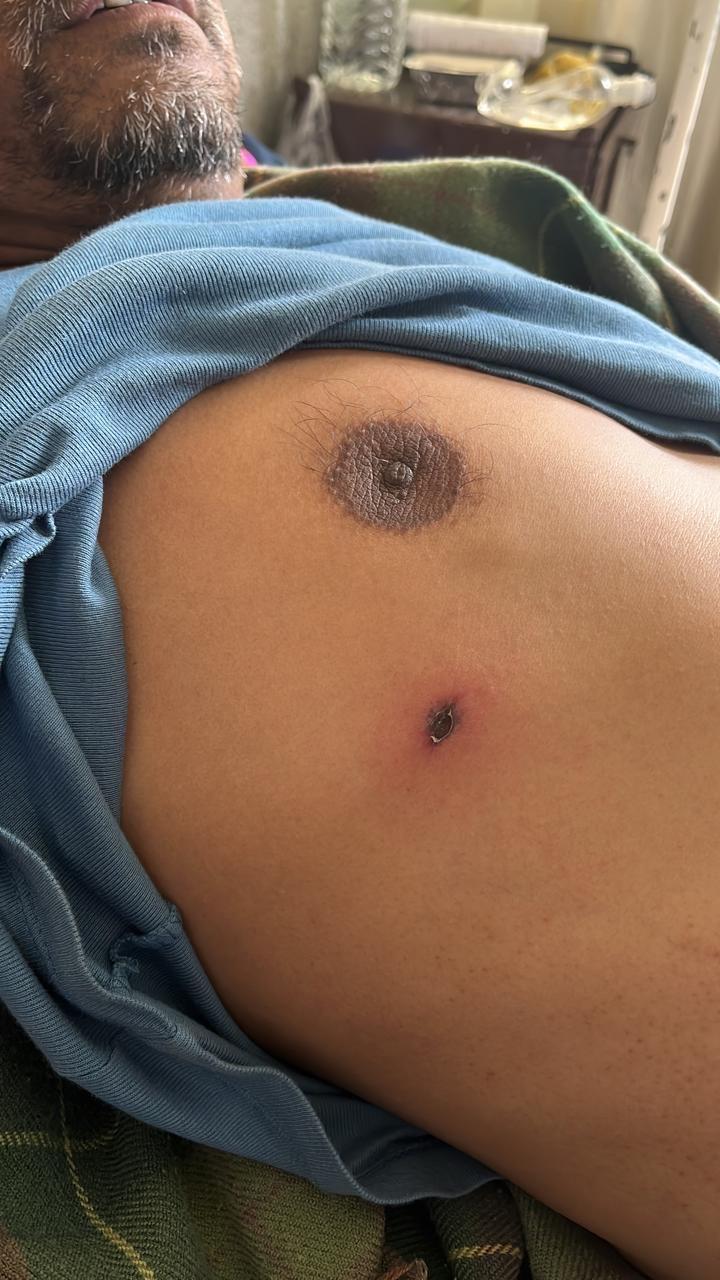
Patient with eschar (picture via Dr Meban Aibor Kharkhongor, Gordon Robert’s Hospital, Shillong, Meghalaya).