
The Infant Mortality Rate (IMR) is more than just a number. It is one of the clearest mirrors of a nation’s wellbeing. A high IMR tells a story of unmet health needs, malnutrition, unsafe water and sanitation, and gaps in prenatal and newborn care.
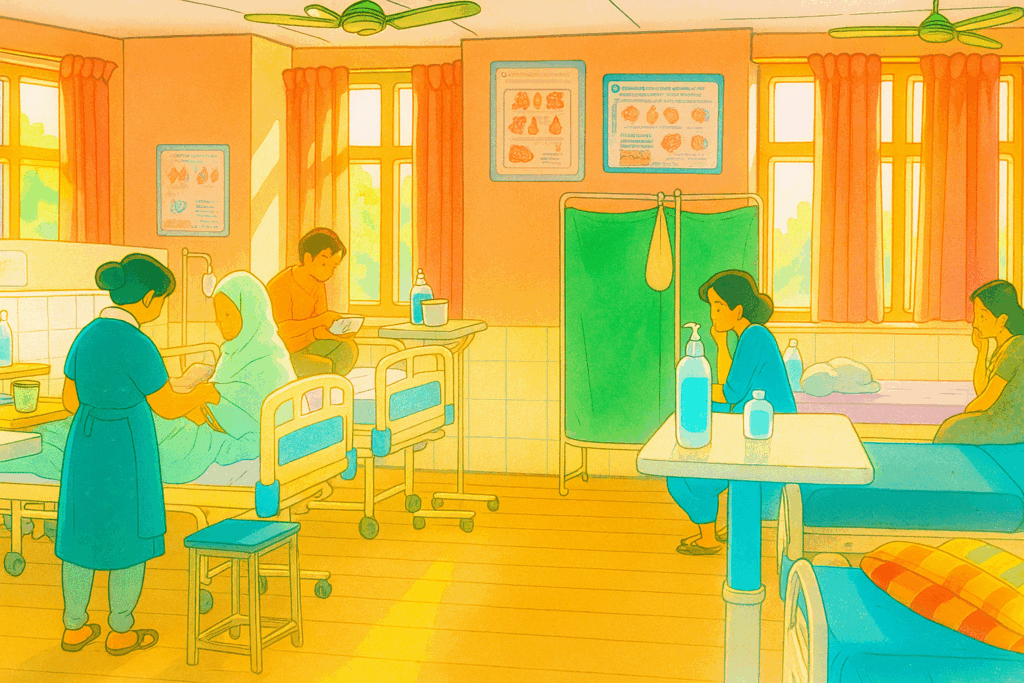
Although India’s IMR has fallen to 25 deaths per 1,000 live births, regional disparities persist. While some regions in India struggle with fragile systems, Kerala, a state in southern India, has achieved a remarkable IMR of 5. That is five times lower than the national figure and even better than some developed countries, such as the United States (5.6). At the same time, the rates in Indian states such as Chhattisgarh, Madhya Pradesh and Uttar Pradesh remain near 37 – they carry disproportionately high infant mortality burdens. In 2023, 16 infants died in a Maharashtra hospital due to medicine and staff shortages. Two years later, in Uttar Pradesh, a woman and her new-born died in an unregistered hospital. These (mediatized) tragedies expose deep cracks in India’s maternal and child health system, where weak infrastructure and poor regulation can turn childbirth into a crisis.
Kerala tells a different story. Its exceptional performance is the result of an integrated model with decades-long investments in public health, primary care, female education, land reforms, and social welfare policies.
What can other Indian states learn from Kerala to reduce infant mortality? Below you find a number of aspects that played a role in the past decades.
1. Strengthening primary health care services with skilled staff, providing round-the-clock service delivery, stabilizing newborns within labour rooms, and establishing a robust referral system to district hospitals. In high-burden regions, extending the operational hours of primary health centres to 24/7, supported by short, intensive training programs on neonatal resuscitation for staff.
2. Targeted neonatal care: Expanding newborn care through Special Newborn Care Units (SNCUs), along with ensuring dependable transport services, is crucial. Kerala’s Mathruyanam program shows how prioritizing safe maternal and newborn transport can save lives. Mapping nearby SNCUs and sharing transfer routes and contacts can further reduce delays especially if the infant has a risk of congenital heart defects.
3. Hridyam: Kerala’s pioneering program for congenital heart disease enabled early diagnosis and treatment. After the launch of the programme, overall infant deaths dropped by 21%.
4. Routine perinatal and neonatal death audits: The swift response mechanism was another pivotal strategy, summarizing findings into quarterly action plans. A non-punitive “no blame” approach improves reporting, while rapid-response teams act quickly in hotspots. Monthly hospital mortality reviews with anonymized case summaries promote peer learning.
5. Focus on social determinants: Investing in female education and maternal empowerment for sustainability. The importance of delayed and spaced pregnancies and enhanced care practices is emphasized as a critical factor that yields intergenerational benefits. Strengthening maternal nutrition programs and implementing adolescent girl nutrition initiatives are key to mitigating risks associated with low birth weight and infections.
6. The empowerment of Accredited Social Health Activists (ASHAs) and Auxiliary Nurse Midwives (ANMs) is pivotal in connecting families to health services. Building the capacity of these frontline cadres with comprehensive training, tools, and incentives ensures early counselling, timely referrals, and consistent follow-up care.
That doesn’t mean, however, that no challenges remain in Kerala.
Underreporting in some areas of Kerala may mask inequities. Districts like Wayanad, Idukki, Palakkad, Kasaragod, and Malappuram still face a higher IMR. Vulnerable pockets like these could be approached with mobile neonatal teams and community outreach. For future gains, rising non-communicable diseases (NCDs) in young women must also be addressed. To sustain the quality of care, burnout among the skilled neonatal nurses and neonatologists should be recognized early and addressed.
A caveat perhaps on the stats: comparisons with the United States, which relies on comprehensive civil registration systems, can be statistically misleading to some extent. Moreover, Kerala’s relatively small annual birth cohort (~350,000) makes its estimates more sensitive to small changes, potentially exaggerating perceived year-to-year differences.
Kerala’s achievement in reducing infant mortality stands as a public health triumph, yet it also exposes a quiet paradox. Indeed, the same state that built one of India’s most equitable maternal and child health systems faces rising out-of-pocket (OOP) expenditures and an escalating burden of NCDs. This contradiction highlights a deeper structural issue: Kerala’s health model is rooted in strong social determinants, but its financing and service delivery systems remain poorly adapted to managing chronic diseases and providing costly tertiary care.
The lesson is not just about scaling its programs but about contextual adaptation, investing in frontline capacity, sustaining community trust, and ensuring equitable financing models that protect families from health shocks. Ultimately, while Kerala’s journey is a benchmark for other Indian states, it also contains a warning: it demonstrates how social progress can translate into better health outcomes, but also how equity and financial protection must remain central concerns to sustain those gains. India’s high-burden states should thus not only try to emulate Kerala’s achievements but also build systems resilient enough to meet the next generation of health challenges.