

The ultimate aim of Universal Health Coverage (UHC) is to ensure that every person has access to basic healthcare, anywhere and anytime. The Government of India, along with many health organizations, has relentlessly made efforts over the years to reach this goal through a variety of policies & interventions, but the journey ahead is still long.
Mental health is one area where the goal of achieving UHC is still far-fetched, in India and many other low-and middle-income countries (LMICs). There are a number of reasons for this, including lack of proper evidence (eg. only 31% of LMICs have conducted a mental health survey in the past 10 years); lack of adequate funding (in India, the share of mental health in the total health budget is merely 1.05% in the Union Budget of 2025); and mental health workforce gaps. Consequently, integration of mental health services in the primary healthcare sector is also slow.
Lately, Artificial Intelligence (AI) is being introduced in mental health, including in India. With a 1:834 doctor-to-patient ratio in India, AI can ease a substantial health care burden.
AI can revolutionize India’s mental health care – almost 150 million people suffer from depression or anxiety, whereas only 30 million receive assistance. An estimated 15% of Indians suffer from a mental health disorder, and the number soared post-COVID-19. AI tools can bridge the gap in treatment through scalable, early-detection care. In spite of a rather difficult macro-economic climate and a minimal health budget, artificial health technology has received some funding as part of digital health funding.
AI in mental health so far
The core principles behind delivering primary mental healthcare to each and everyone are early detection of disorders, timely intervention at a large scale, and ease of receiving treatment. For years, public health professionals and mental health experts have tried to deliver multiple interventions for a variety of mental health conditions through videos, knowledge materials, awareness camps etc., and it wouldn’t be a lie to say that they have destigmatized and treated a chronic condition like depression to a large extent, both globally and in India.
While AI has penetrated deep into our everyday lives—from WhatsApp & Instagram to almost every sector—India has been leapfrogging other countries on digital mental health, and use of AI in particular. Indeed, modern AI and machine learning, specifically, offer vast opportunities for improving prediction, detection, and treatment solutions within the field of mental health care. In terms of prediction and prevention, AI has the ability to assess the risk of developing certain mental health disorders according to an individual’s profile, genetic predisposition, and environmental exposures.
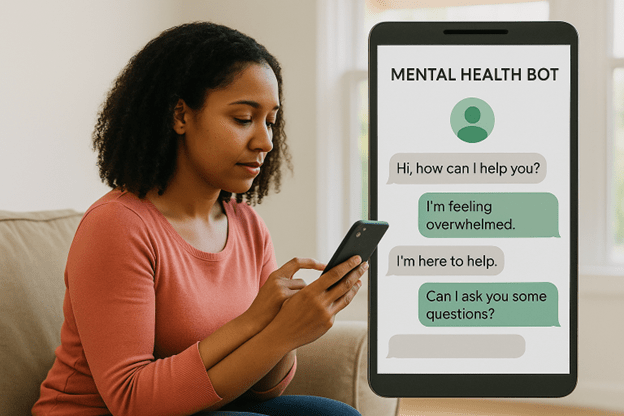
Development of chatbots providing mental healthcare is gaining momentum, with the use of Machine Learning for providing virtual therapy sessions and greater accuracy of detection, Computer vision for assessing the non-verbal cues, facial expressions, and hand gestures, as well as Generative AI providing chatbot assistants, analyzing patient data, and creating therapy plans.
Instead of burning a hole in clients’ pockets for every session offline, people are increasingly shifting to chatbots and applications that provide them with low-cost healthcare treatment while contributing a little to the concept of (more) equitable health systems in India.
The Government of India is increasingly digitizing mental healthcare in India. With the launch of initiatives such as Telemanas focused on mental health and eSanjeevini focused on digital health, the country is standing at the cusp of a digital health revolution.
But are we really benefitting from our new therapists?
As every coin has its downside, AI in mental healthcare is not exempt either. Providing therapy, or listening to another person when he/she talks about what it is that is bothering them, can only to a certain extent be done virtually. Most therapy sessions are based on hours and weeks of trust, sitting through the “quiet phase” of a person who has witnessed a traumatic incident, making three steps of progress one day and going back to square one the very next day. All of these are possible because of a human’s touch, their training & patience, and their unconditional positive regard. Most mental health chatbots, on the other hand, store not just age and gender but also mood triggers, relationships, sleep patterns, and even genetic data—raising serious risks of surveillance capitalism.
While many researchers try to navigate the mystery behind the success of chatbots, the real concern lies in the conforming nature of (many) AI-based chatbots. The “coding” of chatbots is such that they often agree with what we tell them, instead of discerning what happens behind the scenes, hence sometimes they’re conforming to our story. There’s a difference between “Do you think this thought is justified?” and “I think this thought is justified, right?” and this is what AI fails to recognize.
Bottom line: towards the best of both worlds
Health is a sector of multiple beneficiaries, and introducing AI in mental health has surely led to benefits for many stakeholders. However, when we speak of digital mental health, what our system really needs is an end-to-end model that entails knowledge regarding the role of psychologists/therapists, knowledge materials that are carefully designed by mental health professionals on the common mental health problems in India, and what the first steps are if a person relates what they are feeling to the provision of that information. AI in mental health needs stricter rules on dashboards, prompts, data safety, and timely professional input.
Yes, AI will be an important tool on the journey towards achieving UHC, but medical help shouldn’t only come from a chatbot or avatar. Using AI for mental health purposes is great, but so is knowing when to seek help from a professional. At least, if we’re aiming for the best of both worlds.