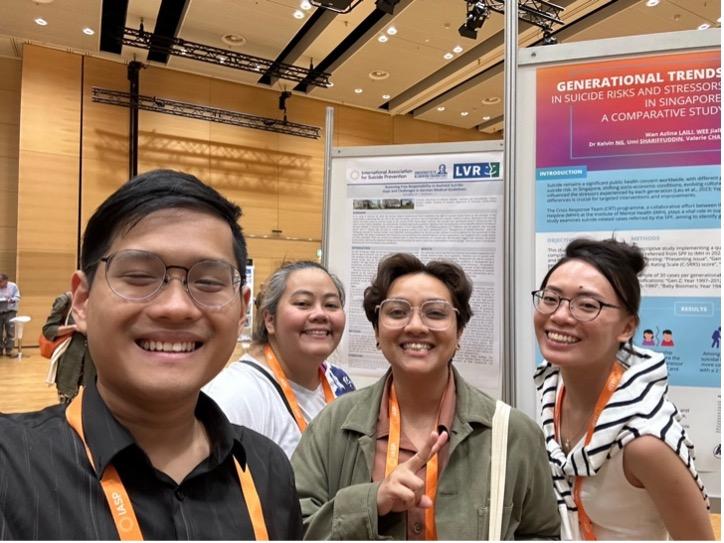

Last month, I had the privilege to present at the 33rd International Association of Suicide Prevention (IASP) World Congress, held in Vienna, Austria. The event brought together global experts, including researchers, clinicians, policymakers, and advocates—to share knowledge, exchange best practices, and collaborate on strategies to address suicide as an urgent public health issue.
As part of Project Hayat (meaning “life” in Malay), a ground-up initiative from SG Mental Health Matters that unites suicide survivors, researchers, practitioners, employers, and community groups to co-develop a national suicide prevention strategy in Singapore, my colleague Glen Koh and I presented a poster on the barriers and opportunities in implementing media guidelines for suicide reporting in Singapore. We represented the Global Mental Health team of SingHealth Duke-NUS Global Health Institute (SDGHI).
Suicide as a Major Public Health Concern for Singapore
Suicide remains a major public health concern, resulting in the loss of over 700,000 lives annually according to the World Health Organization. In Singapore, suicide continues to be the leading cause of death among youths aged 10 to 29, accounting for approximately 30 percent of all deaths within this age group. This highlights the urgent need for effective suicide prevention efforts both in Singapore and globally.
Currently, Singapore lacks a national suicide prevention strategy that emphasises the importance of media guideline implementation in suicide prevention. Evidence has shown that responsible reporting practices help to mitigate potential contagion efforts and support suicide prevention efforts with stories of strength and stigma reduction.
As a result, our poster highlighted key gaps in media coverage and reporting on suicides in Singapore. These include structural inconsistencies in existing guidelines, high level of stigma associated with suicides, alongside platform-specific differences between traditional and social media. The poster also highlighted various opportunities for the implementation of media guidelines in Singapore, including the promotion of strength-based narratives that highlights an individual’s mental health recovery and resilience to reduce stigma and inspire hope in the community, especially among vulnerable population groups.
Lived experiences and how to safely integrate them into advocacy
One of the most powerful takeaways that I learned from this event was how to safely integrate lived experiences into my advocacy journey. As a junior advocate for mental health and suicide prevention, I’ve come to recognise that lived experience alone does not automatically prepare an individual for advocacy, and without the right support, individuals risk feeling tokenised or retraumatised.
As such, to prevent this from happening, it’s essential to offer pre-engagement orientations that clearly outline the nature of the partnership, emotional risks, available opportunities, and the right for participants to opt out, ensuring that participants’ informed consent is always obtained. To be able to do so, centring power-sharing and honouring diverse experiences are critical to fostering equitable and respectful engagement.
Being part of the IASP Congress deepened my understanding of how urgently Singapore needs a coordinated, inclusive, and evidence-based national suicide prevention strategy. It also reinforced for me that strengthening media guidelines and ethically amplifying lived experience must be essential parts of this roadmap.
While there’s still much work ahead, the energy and collaboration I witnessed in Vienna gave me hope. It showed me that with the right partnerships and support, we can move beyond fragmented efforts toward a shared national vision — one that saves lives and upholds the dignity of those affected by suicide.
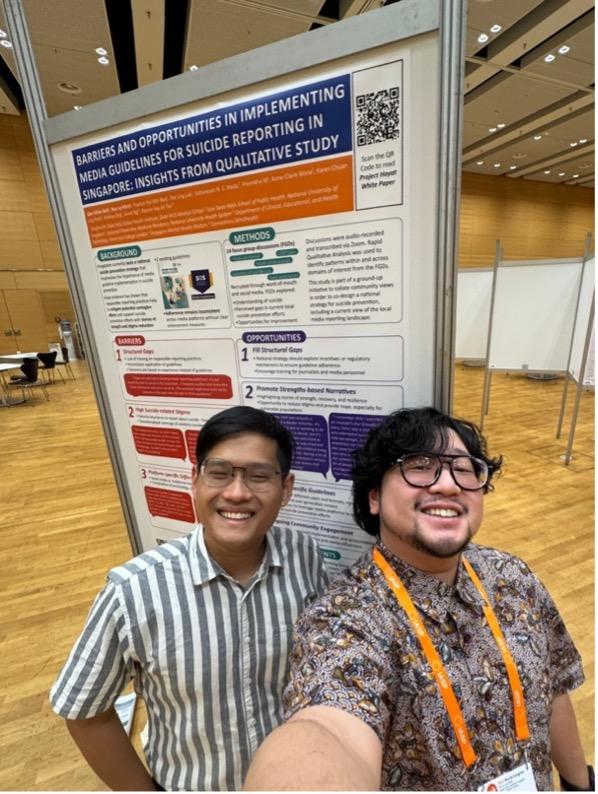
Together with Glen Koh, a member of SDGHI’s Global Mental Health team