This year, I attended the 24th International Vaccinology Course (IVC) 2025 in Seoul, South Korea (8-12 September). In this short article, I’ll focus on some lessons Africa could learn from South Korea on the journey towards more health sovereignty – more in particular on vaccines.
But let’s kick off with a bit of info on the course. As I’m currently a WHO/TDR Clinical Research
Leadership fellow in Seoul, I’ve been in the country for some months now.
Unlike many programs that remain bound to a single location, the IVC is delivered
simultaneously across three hubs: Seoul (IVI Headquarters), Kigali (IVI Africa Regional Office),
and Stockholm (IVI European Regional Office). The organizers even factored in time zones to
ensure real-time engagement, while also offering a virtual option that opens the doors to an
even wider global audience. This blended model doesn’t just enrich the course with diverse
perspectives from every corner of the world; it also reflects a growing commitment to
sustainability by reducing the carbon footprint often associated with international travel.
The course featured three panel discussions, a cultural visit to the Korean museum, and,
perhaps most memorably, a site visit to a state-of-the-art bio hub.
Songdo International City: Global Biopharma Powerhouse
Indeed, as part of the IVC, we had the opportunity to visit a remarkable hub, home to the
world’s leading biopharmaceutical production capacity concentrated in a single city. Songdo,
just 30 km southwest of Seoul, hosts not only major global raw material and subsidiary
companies such as Saint-Gobain, Merck, Cytiva, and Sartorius, but also industry giants like
Celltrion and Samsung Biologics. Among them, Samsung Biologics and SK Bioscience are
particularly well known for their vaccine manufacturing. Altogether, nearly 70 companies have
joined forces to create this powerful biocluster.
To put its scale into perspective: Songdo’s production capacity stands at 560,000 liters of
biopharmaceutical products, far surpassing San Francisco (440,000 liters), Singapore (270,000
liters), and Ireland (230,000 liters).
Songdo is also a training ground for global talent in bioprocessing. South Korea was recently
(2023) chosen as the WHO Global Biomanufacturing Workforce Training Hub (GTH). In fact, I
personally had the chance to attend the GTH-Biomanufacturing training this July, alongside
many professionals from low- and middle-income countries (LMICs).
More in general, South Korea offers one of the unique examples of how deliberate policy, such
as Bio-Vision 2016, sustained investment, reduced tariffs on vaccine materials through
partnerships with WTO member states and strong public-private partnerships can transform a
country’s position in the global health ecosystem. The Biotechnology industry in South Korea
has grown exponentially since the 1990s. Foreign investment in Korea is also growing fast
making Korea home to now over 1,000 biotech companies.
Since 2021, nearly $2 billion has been allocated over five years to position Korea as a global
vaccine hub. Today, South Korea contributes 11% of the global vaccines supply to GAVI, the
Vaccine Alliance, making South Korea GAVI’s fourth-largest global vaccine supplier and ranked
as one of the top five global vaccine producers in 2025. “Mission accomplished”, I guess.
Africa’s ambition
African countries and South Korea share a strikingly similar ambition: to achieve self-sufficiency
in vaccine and biologics production. But from the above, it’s clear South Korea is far ahead.
As most of you will know, a few years ago the Africa Centre for Disease Control set an ambitious
target of achieving vaccine self-sufficiency by 2040 through local production. To achieve this,
Africa will need over 12,000 skilled professionals in the vaccine manufacturing ecosystem.
Change is already visible, for eg, through initiatives such as ACHIEVE 2.0 from the International
Vaccine Institute (IVI). ACHIEVE 2.0 aims to mobilize funds for Africa-based, end-to-end vaccine
research and development, production, approval, and uptake. So far, Nigeria, Ghana, and
Zambia have committed US$ 25 million over the next five years, an important first step toward
African ownership of vaccine manufacturing, though two more countries are needed to reach
the target of five committed nations. Ethiopia has also expressed interest, and discussions are
currently underway. Many other initiatives are seeing the light, with Africa CDC as a key driver
of this agenda.
Yet major roadblocks remain: strategic initiatives, substantial investment in developing bio
industries, multi-ministerial coordination, an efficient budget allocation system, and strong
leadership will all be required to mimic South Korea’s successful journey of the past decades.
Momentum
Africa’s population is nearly 29 times larger than South Korea’s, and the collective GDP is about
1.5 times greater. The real question is not whether Africa can produce world-class vaccines like
South Korea, but when it will start to do so. South Korea’s journey certainly offers a roadmap.
There is certainly momentum in Africa, as first the pandemic and then subsequent global
political shifts made it abundantly clear that health sovereignty is absolutely vital. It won’t be
easy though, as the geopolitical environment is difficult and the pandemic agreement reached
earlier this year still needs an important annex (on Pathogen Access and Benefit Sharing ) which
should facilitate vaccine technology knowledge transfer and equitable benefit sharing.
Yet, by learning from South Korea’s strategies and tailoring them to the African context, Africa
can no doubt build sustainable vaccine production capacity and, ultimately, secure true health
sovereignty for its people.
Instead of asking “Why Africa”, the world increasingly reckons, “Why not Africa?“.
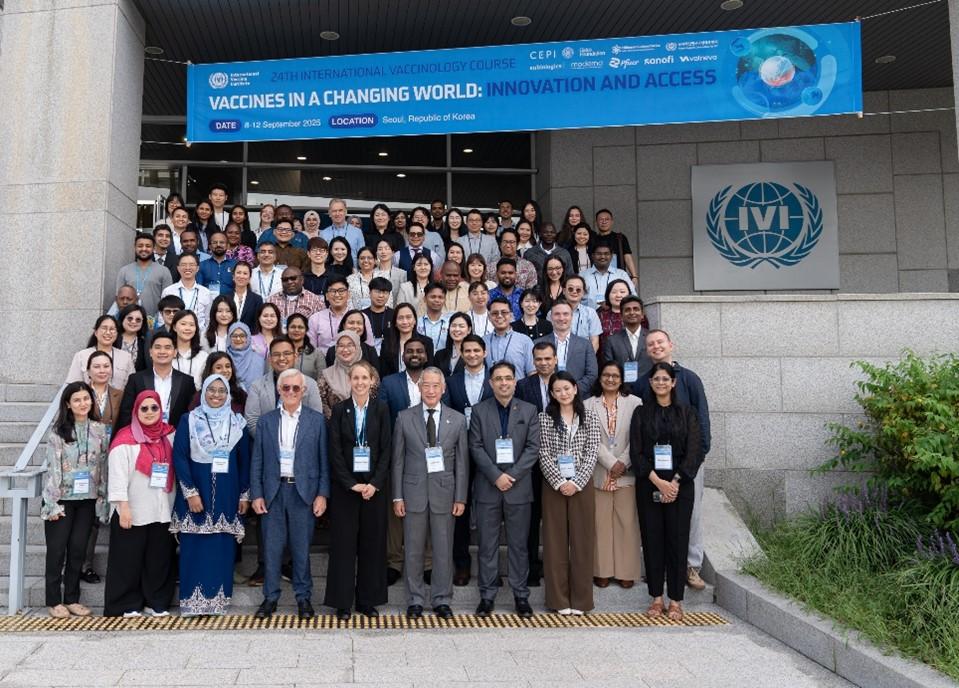
Participants of the 24th International Vaccinology Course (IVC), Seoul, South Korea (2025).